Accessibility tools
Powered by  Translate
Use the boxes below to change the website colours.
Visit disclaimer page for more information about the accessibility tool.
New Burns Garden unveiled at Eglinton Country Park
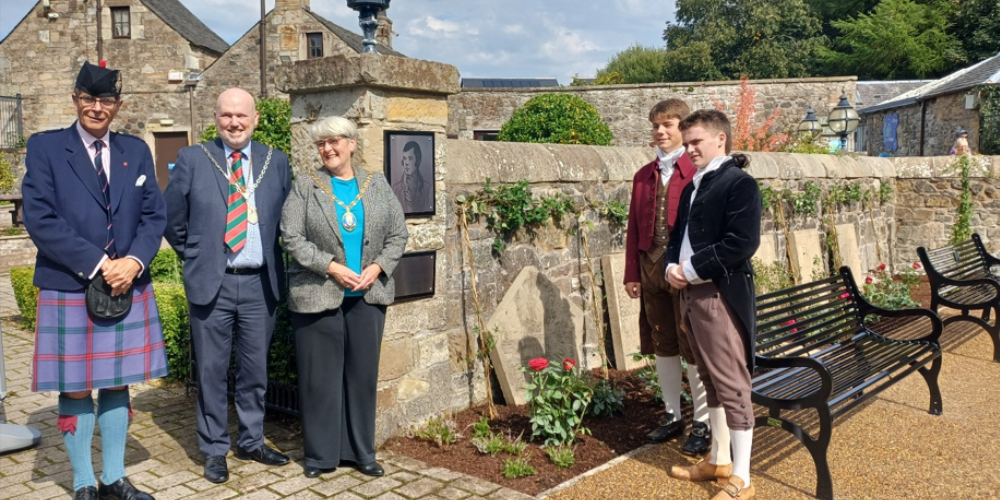
A new Robert Burns Garden has been unveiled at Eglinton Country Park to celebrate the 200th anniversary of the formation of the Irvine Burns Club.
Located within the courtyard at Eglinton Country Park, the garden has been inspired by the life and words of Scotland’s National Bard and contains flowers and plants that Burns refers to in his poetry and songs.
The official opening was held on 30 August and guests included the Earl and Countess of Eglinton, members of Irvine Burns Club, North Ayrshire Council Provost Anthea Dickson, the Marymass Royal Party, Patricia Gibson MSP, Elected Members, Officers of North Ayrshire Council and representatives from Burns clubs across North Ayrshire.
Guests were entertained by performances from the North Ayrshire Senior Schools Strings Orchestra and singer David Douglas.
The guests were then treated to a poetry reading by Greenwood Academy pupils Riley McClory and Johnny Cripps who depicted Robert Burns and Captain Richard Brown, an Irvine born sailor who is credited as being the person who, when walking with Burns through Eglinton Woods, advised him that he should publish his poetry.
So how did the beautiful new heritage garden come about?
North Ayrshire Provost, Anthea Dickson explains: “On 2nd June 1826 twelve men, eleven of whom personally knew Robert Burns, met and agreed that Irvine should honour the poet who had once lived in their town. On that night, the Irvine Burns Club was founded.
“200 years later, North Ayrshire Council are delighted to have partnered with Irvine Burns Club to create the Robert Burns Garden to celebrate the 200th anniversary of the Club.
Quote: It has been a privilege to have been part of the official opening of this inspiring community garden established to reconnect visitors and local people alike to the legacy of our National Bard, Robert Burns. Thank you to everyone involved in this project that will further enrich the heritage and vibrancy that our local country park has to offer. Special thanks to Donald Wilson of Irvine Burns Club who gave up so much of his time to sourcing, planting and creating this garden.
Quote from: Councillor Anthea Dickson, Provost of North Ayrshire Council
Peter Latham, President of Irvine Burns Club said: "This is not simply about opening a new public space. It is about celebrating a man whose words have inspired generations, crossed continents, and spoken to people from all walks of life for more than two centuries. Burns was a poet of the land, of the people, of friendship, love, equality, and hope. It is therefore fitting that we honour him in a garden, surrounded by the beauty and tranquillity of nature that so often inspired his verse."
A beautiful etched portrait of Burns was designed by local artist Jack Sutton, also in attendance. Jack shared: “This was a great comfort-zone-obliterating project for me. It was extremely interesting for me personally and a challenge artistically. Attending the beautiful opening event fully brought home the significance of the project and a lot of the best of what Burns means to folk. The opening made me pretty emotional, and it was an absolute honour to be involved.”
The garden also includes paving sculptures by Ian Cooper, commissioned by the Eglinton Burns Club. They were initially installed outside the Carrick Hostelry at Irvine Cross (formerly the Eglinton Arms) and commemorate the 200th anniversary of Burns’ death.
The sculptures depict the medicinal plants used by the doctor who treated Burns during his time in Irvine and make a fitting centrepiece to the newly created garden.
Robert Burns left his family farm Lochlea, near Tarbolton, in the summer of 1781 and came to Irvine to learn the trade of flax dressing. It was during his time in Irvine that Burns turned his dreams of becoming a poet into reality and having arrived in Irvine as an apprentice flaxdresser, he then left as an apprentice poet.
During his time in Irvine, Burns formed a strong friendship with Captain Richard Brown, an Irvine sailor and it was Captain Brown who encouraged Burns to consider publishing his works. After the successful publication of his “Poems Chiefly in the Scottish Dialect”, first published in Kilmarnock in 1786, Burns wrote to Brown:
“Do you recollect a Sunday we spent together in Eglinton Woods? You told me on my repeating some verses to you that you wondered that I could resist the temptation of sending verses of such merit to a magazine? Twas actually this that gave me an idea of my own pieces which encouraged me to endeavour at the character of a poet.”
Pictured (above, left to right) are the Earl of Eglinton; Peter Latham, President Irvine Burns Club; Provost Dickson; Riley McClory (Robert Burns), and Johnny Cripps (Captain Richard Brown).
Published: 01 September 2026