 Translate
1. Welcome
The core purpose of effective performance management is to improve the lives of the people we serve by using high quality information to make decisions.
We believe the impact our services have on our residents, employees, businesses and visitors cannot be demonstrated through charts alone. It requires a balance of quantitative and qualitative information such as real lived experiences and case studies to measure impact, provide context and effectively inform decision making. This approach relies on excellent communication between all teams to share information and is supported by both the Accounts Commission’s Direction 2024 and the Scottish Government’s National Performance Framework.
This strategy has been refreshed during 2025 to reflect changes in statutory requirements such as the Best Value Thematic Approach and Statutory Performance Information Direction 2024. It outlines how our performance management supports a culture of continuous improvement within our council to deliver our priorities and provide positive outcomes for our people. It provides an overview of statutory context and our current performance management arrangements.
It is intended this refreshed strategy will be actively used as a reference by Elected Members and Officers across our council through integration with performance management training. This assists in evidencing an embedded approach to robust and transparent performance as required within reasonable procedures under The Economic Crime and Corporate Transparency Act 2023 (ECCTA).
The strategy includes an overview of planned developments to ensure continuous improvement within our performance management up until 31st March 2028 (coinciding with the lifespan of our current Council Plan). Innovation to ensure effective and transparent performance management will be central to our activities. We reviewed the outcomes of our previous Performance Management Strategy and these have informed our approach.
This strategy does not attempt to list the vast range of improvement activities currently underway in our council. These are already covered through existing strategies published on our website.
Finally, strategies are purely a mechanism to structure the delivery of services, a map not a destination. Our mission remains working together to improve the lives of our people in North Ayrshire, to fulfil our aim of a North Ayrshire that is fair for all.
For further information please contact:
The Corporate Policy and Performance Team
Telephone: 01294 310000
Email: NorthAyrshirePerforms@north-ayrshire.gov.uk
2. Key objectives
- Empower and support teams to embed continuous improvement throughout our council.
- Establish an effective dynamic performance management framework that reflects our services.
- Embed continuous improvement for the people we serve through effective performance management.
- Focus on efficient, transparent and robust performance management, minimising duplication and embracing innovation.
- Enhance accessibility through relevant, clearly understood publications, available through a variety of channels for our residents and stakeholders.
- Collaborate with and learn from teams across our council and beyond.
- Encourage and support effective scrutiny at all levels within our council as well as by external stakeholders.
- Establish the Corporate Policy and Performance Team as a key point of contact for performance management.
3. Statutory duty and national context
This section outlines the statutory duty of Best Value and the national context that needs to be considered within Our Performance Management Strategy.
3.1 Best Value
Best Value is a statutory duty as set out in the Local Government (Scotland) Act 2003 and applies to all public bodies in Scotland. Its core purpose is to ensure good governance, effective use of resources and continuous improvement in order to deliver better outcomes for our people.
A new approach to auditing Best Value within Scottish councils came into effect during 2022 to 2023. (Note: This approach relates to councils only. The Accounts Commission decided in 2021 not to proceed with Best Value audits of Integrated Joint Boards (IJBs) following a pilot and national policy developments. Broad local and national audits of IJBs will be used instead.)
The new annual Best Value Thematic Approach explores a particular area of Best Value each year. The theme covered reflects local government risks and challenges and is determined by the Accounts Commission each year. The Accounts Commission’s work programme can be viewed on their website.
All 32 local authorities are audited on the selected theme by their external auditors. The results of the audit are integrated into the Annual Audit of each council in the autumn. In addition, a national thematic report is produced to show a Scotland-wide view of performance.
At least once every five years a council’s performance is highlighted to the Accounts Commission by the Controller of Audit through a Section 102 report. This report covers the recent Annual Audit Reports and a summary of the Best Value work and recommendations. Our most recent Section 102 report was presented to the Accounts Commission in October 2025 during a public session. Resulting recommendations were confirmed at a private session and will be considered by Council in December 2025. Section 102 reports activate specific statutory responsibilities such as making the report publicly available, promoting a meeting of Council to consider any findings and the publication of these findings. The final audits under this current programme of Best Value will be completed in August 2027.
Where an audit identifies areas for improvement, the recommendations and updates on progress are included in our six-monthly Council Plan Progress Reports, scrutinised by the Executive Leadership Team (ELT), Cabinet and the Audit and Scrutiny Committee. Actions are monitored within the audit year by the appointed external auditors (Audit Scotland) on behalf of the Accounts Commission.
3.2 Statutory Performance Information Direction 2024
The Accounts Commission has the statutory power to determine the performance information that must be published by local authorities under section 1(1)(a) of the Local Government Act 1992.
The Accounts Commission’s Statutory Performance Information Direction 2024 came into effect for financial years beginning 1st April 2025, 2026 and 2027. It defines how local authorities should demonstrate they are achieving Best Value for their residents. This includes through the comparison of information over time (at least three years where possible) and with other similar councils (benchmarking, including with councils of a similar budget size, rurality, demographic and socioeconomic characteristics) to support learning and continuous improvement. It also considers how we are working with partners to deliver better outcomes for our people of North Ayrshire, particularly through our Community Planning Partnership (CPP).
The Direction is more detailed than in recent years and supported by accompanying guidance. This guidance is intended to be published in stages with the next publication due in October 2025. It is important to note that:
Quote: The Commission does not seek to instruct or advise councils on how to implement its arrangements for performance management. It is for each council to determine how to meet the requirements of the SPI Direction through its own approach to and procedures for managing and reporting on performance, and each council is wholly responsible and accountable for ensuring its compliance with the Direction.
Quote from: Accounts Commission, Direction 2024 Guidance, April 2025; paragraph 4
Through our reporting we are expected to demonstrate:
- how we are working with partners to achieve shared local outcomes
- how we are responding to the needs of our local communities
- how we are learning from best practice elsewhere
- what factors are impacting on our performance
- how are we using data to inform decision-making
- how we measure success
The three criteria of effective reporting are: Balanced, Timely and Accessible. Key focus areas within this Direction include:
- Self-Assessment and Peer Review: See Self-Assessment section below.
- Accessibility: Our performance reporting is produced to enable our residents to engage with and effectively scrutinise our performance. Accessibility in terms of the Direction relates to the information being engaging and easily understood (referred to in the guidance as “non-technical”) and accessible in terms of equality legislation (“technical”).
- Partnership working between the Community Planning Partnership (CPP) and our council and interlinking (not merging) of reporting to ensure the contribution of our council to the shared CPP outcomes is visible.
- Financial sustainability and budget transparency.
- Utilising the Local Government Benchmarking Framework (LGBF) information within our Council Plan reporting, Annual Accounts and to inform service delivery.
- Timely and balanced reporting: Information should be published in an appropriate timescale, with the Direction outlining maximum timeframes. In addition, where performance is adrift of target, improvement activity and the expected timeframe for improvement must be included.
- Audits, inspections, accreditations and community engagement, particularly how our council is responding to ensure continuous improvement as part of our duty to secure Best Value.
Ultimately the focus remains on using robust information for transparent and evidence-based decision making to support our priorities and improve the lives of our people in North Ayrshire. This includes informing our transformation activity.
Council Plan reporting is the main mechanism for demonstrating Best Value however the Direction is not confined to corporate reporting. The Direction should be considered for all our public facing reporting as this reporting also supports our priorities.
Quote: Each local authority shall, in accordance with section 13 of the Local Government in Scotland Act 2003 and associated regulations and guidance from Scottish Ministers, publish the information specified in the Schedule to this Direction for all activities which are carried out by the body.
Quote from: Accounts Commission, Direction 2024
3.3 National Performance Framework
The Scottish Government’s National Performance Framework aims to create a more successful country with more opportunities and better wellbeing for the people of Scotland. It looks to create sustainable and inclusive growth and reduce inequalities by giving equal importance to economic, environmental and social progress and aligns to the United Nations’ Sustainable Development Goals.
Under the Community Empowerment Act 2015 local authorities must have due regard to the 11 National Outcomes within the National Performance Framework. These were considered during the development of Our Council Plan 2023 to 2028 alongside the priorities of our residents.
Following the most recent statutory review of the National Outcomes by the Scottish Government, in January 2025 the Scottish Parliament approved a period of reform of the National Performance Framework, of which the outcomes form part. The new framework is expected to be implemented near the start of the next parliamentary session by the new government.
The National Performance Framework directly influences the outcomes within Our Council Plan, though our priorities are those agreed with our residents in line with our statutory duty of Best Value under the Local Government (Scotland) Act 2003.
3.4 The Local Government Benchmarking Framework
The Local Government Benchmarking Framework (LGBF) is administered by the Improvement Service in partnership with SOLACE. The Accounts Commission:
Quote: expects councils to maximise the use of the Local Government Benchmarking Framework (LGBF) as a primary means of facilitating comparisons, alongside or in conjunction with other locally appropriate measures of performance
Quote from: Accounts Commission, Direction 2024
As a result, many of the indicators are used within our Council Plan.
By recording the same indicators as other local authorities across a wide range of themes we can identify opportunities to learn from each other. The Direction 2021 gave scope to focus on the LGBF indicators that directly link to our Council Plan priorities. South Lanarkshire Council took this approach as highlighted by the Accounts Commission in the Local Government in Scotland Overview 2023. As a result, we adopted this approach in 2023 and currently have 33 priority LGBF indicators (see Our Council Plan Performance Management Framework section below).
Local authorities with similar traits such as type of geography and levels of deprivation are categorised into ‘family groups’ to enable as close to a like for like comparison as possible. Despite the Direction 2024 directing councils to benchmark based on additional relevant aspects such as budget size and demographic information, the LGBF is not currently segmented in this way. Further work will be undertaken by our council to enable this.
Performance can be explored through the LGBF online tool by clicking the image above. Further information is contained in the Benchmarking section of this strategy.
3.5 Failure to Prevent Fraud Corporate Offence
The Economic Crime and Corporate Transparency Act 2023 (ECCTA) came into effect on 1st September 2025. Sections 199 to 206 of the Act introduce a new criminal corporate offence of Failure to Prevent Fraud. This applies to large organisations including our council. Liability occurs when a person associated with the organisation commits a specified fraud offence with the intention of benefiting the organisation. This includes misrepresenting performance information.
Benefits include but are not limited to financial and reputational gain, such as providing a more favourable view of performance or withholding information to either gain additional external funding or improve the organisation’s status in national frameworks. It is important to note that the intention of benefiting, rather than realising any benefit, is enough to qualify as an offence.
This is an offence of strict liability which means there is no requirement to prove knowledge or consent of senior management. The legislation focuses not on individual, but organisational responsibility for such an offence.
Reasonable procedures to prevent such fraud must be in place and actively followed. The Scottish Government outlines six non-statutory principles to assist organisations to help determine reasonable procedures:
- Top Level Commitment – The Executive Leadership Team and Elected Members must be committed to and encourage the prevention of fraud, including through training.
- Risk Assessments – Actively identifying the risk of fraud, including by considering the three key elements of opportunity, motive and rationalisation, which may lead to fraudulent activity taking place.
- Proportionate Procedures – Procedures are tailored to the size, complexity and risk of fraud within an organisation. They must be practical, effectively implemented and enforced.
- Due Diligence – This must be undertaken when procuring services and working in partnership.
- Communication and Training – Consistent training to increase and maintain knowledge is essential.
- Monitoring and Review – Regular reviewing through our own fraud detection procedures as well as considering information from sector investigations elsewhere.
This puts an increased emphasis on the importance of transparent performance management. To enable this, clear SMART strategies at every level within our council are essential. A strategy is not effective unless it is being actively measured, managed and scrutinised.
3.6 Scottish Government Public Sector Reform Strategy
Informed by the Christie Commission on the Future Of Public Services, the Scottish Government’s Public Sector Reform Strategy ‘Delivering For Scotland’ aims to revisit the findings of the commission and drive improvements within the public sector nationally. The preventative approach identified by the Commission, relying on robust, efficient and effective data to drive evidence-based decisions, as well as improved integration of services, improved scrutiny, and focus on engagement with our people, are elements taken forward at a local level within Our Council Plan.
3.7 Local Government Assurance and Improvement Framework
The Local Government Assurance and Improvement Framework maps the complex scrutiny and governance environment of local government. It aims to improve local and the Scottish Government understanding of the scrutiny landscape and ultimately inform more efficient working in line with the Crerar Review.
3.8 Future considerations
3.8.1 National Performance Framework
As mentioned above, a refreshed National Performance Framework is expected to be implemented near the start of the next parliamentary session and new government. This will be monitored and this strategy updated as required. It is likely the new framework will influence our next Council Plan.
3.8.2 Recommitting to Crerar - National Framework for self-assessment
Informed by The Crerar Review and Public Sector Reform Strategy detailed above, SOLACE and the Improvement Service are leading a project under the heading “Recommitting to Crerar”. This looks to improve the scrutiny and self-assessment landscape between various bodies, local and central government in Scotland. A National Framework for Self-Assessment is due to be published in early 2026 as an initial step, strengthening the approach in a collaborative way nationally. Our council is contributing to this work through engagement sessions open to all local authorities. (See Self-Assessment section below.)
3.8.3 SPI Direction 2024 Guidance
The iterative approach to publishing guidance on the SPI Direction 2024 will require close monitoring and action as required. At time of writing (October 2025) the next release of guidance is expected this month. If similar to previous releases, examples of best practice will be included and examined to inform our approach.
3.8.4 Local Government Data Platform
The Local Government Data Platform (LGDP) is a significant transformational project initiated by the Improvement Service during 2020 to 2021. The aim is to simplify how local authorities return data nationally, rationalise the data by creating a central point of access for external organisations and increase the use of this data. The discovery phase identified more than 30 public sector reporting duties which in total included over 24,000 data items shared with external organisations per local authority per year (excluding individual level data which resulted in over 3 million items shared).
The final phase 2 report on key findings and next steps will be presented to SOLACE and COSLA in late 2025/early 2026.
4. Local context
This section outlines local context that needs to be considered within Our Performance Management Strategy.
4.1 The North Ayrshire Partnership Plan
The North Ayrshire Partnership Plan (Local Outcomes Improvement Plan (LOIP)), is administered by our North Ayrshire Community Planning Partnership. It consists of public, private and voluntary organisations and groups working together with communities through our six Locality Partnerships to make North Ayrshire a better place to live. The Community Plan has three themes, the delivery of which aligns to Our Council Plan priorities:
- Wellbeing – Health and Wellbeing – Reducing inequalities by targeted support to improve individual, family and community wellbeing.
- Work – Economy and Skills – Addressing the causes and effects of poverty through a strong local economy and skills base.
- World – Climate Change – Working more closely and effectively together to reduce carbon emissions and mitigate the impacts of climate change.
4.1.1 Locality Plans
One of the key methods of participation in North Ayrshire is through locality planning, including the work of the locality partnerships which bring together our Community Planning Partners, Elected Members and community representatives to jointly address local priorities. Locality Plans are created by each of the six Locality Partnerships in North Ayrshire. Though supported by officers within our council, the priorities and plans are led by our communities. As such, priorities vary by locality.
Locality Planning is outlined in the Community Empowerment (Scotland) Act 2015 as a way for Community Planning Partners to tackle inequality in a targeted and cohesive manner. North Ayrshire Locality Planning arrangements are established through the North Ayrshire Decentralisation Scheme in terms of section 23 of the Local Government etc. (Scotland) Act 1994, as well as complying with Part 2 of the Community Empowerment (Scotland) Act 2015. Locality Partnerships are chaired by Elected Members as agreed by our council. Since the alignment of Elected Member wards to locality boundaries in 2019, Elected Members sit on one Locality Partnership.
A programme of self-assessment took place during summer/autumn 2024 under the title ‘Locality Planning 2.0’. This received feedback from representatives showing members of the locality partnership felt a high level of involvement and ownership of the partnership. Potential areas for improvement, particularly around meetings, were highlighted and will be taken forward as appropriate. A report on the assessment was approved by Cabinet in May 2025.
4.2 Our Council Plan 2023 to 2028
Our Council Plan 2023 to 2028 is the main strategy for our council for five years. Our vision ‘A North Ayrshire that is fair for all’ is shared with The North Ayrshire Partnership Plan (LOIP). Our mission ‘Working together to improve the lives of our people in North Ayrshire’ demonstrates how working with partners and continuous improvement are embedded within our culture to improve the lives of our people.
Our Council Plan outlines our priorities created in partnership with our residents and is aligned to the Partnership Plan. It is the core basis of our statutory performance reporting as required in the Accounts Commission SPI Direction 2024. Every strategy and plan within our council must align to it.
The North Ayrshire Health and Social Care Partnership is responsible for the delivery of key areas of our Council Plan through the Integration Joint Board’s Strategic Plan. Delivery of the Strategic Plan is reported separately to the Integration Joint Board, the IJB’s Performance and Audit Committee and through the Annual Performance Reporting to the Council and NHS Board. There is an established performance management framework in place within the Health and Social Care Partnership with progress reported on an integrated basis for delegated Health and Social Care Services.
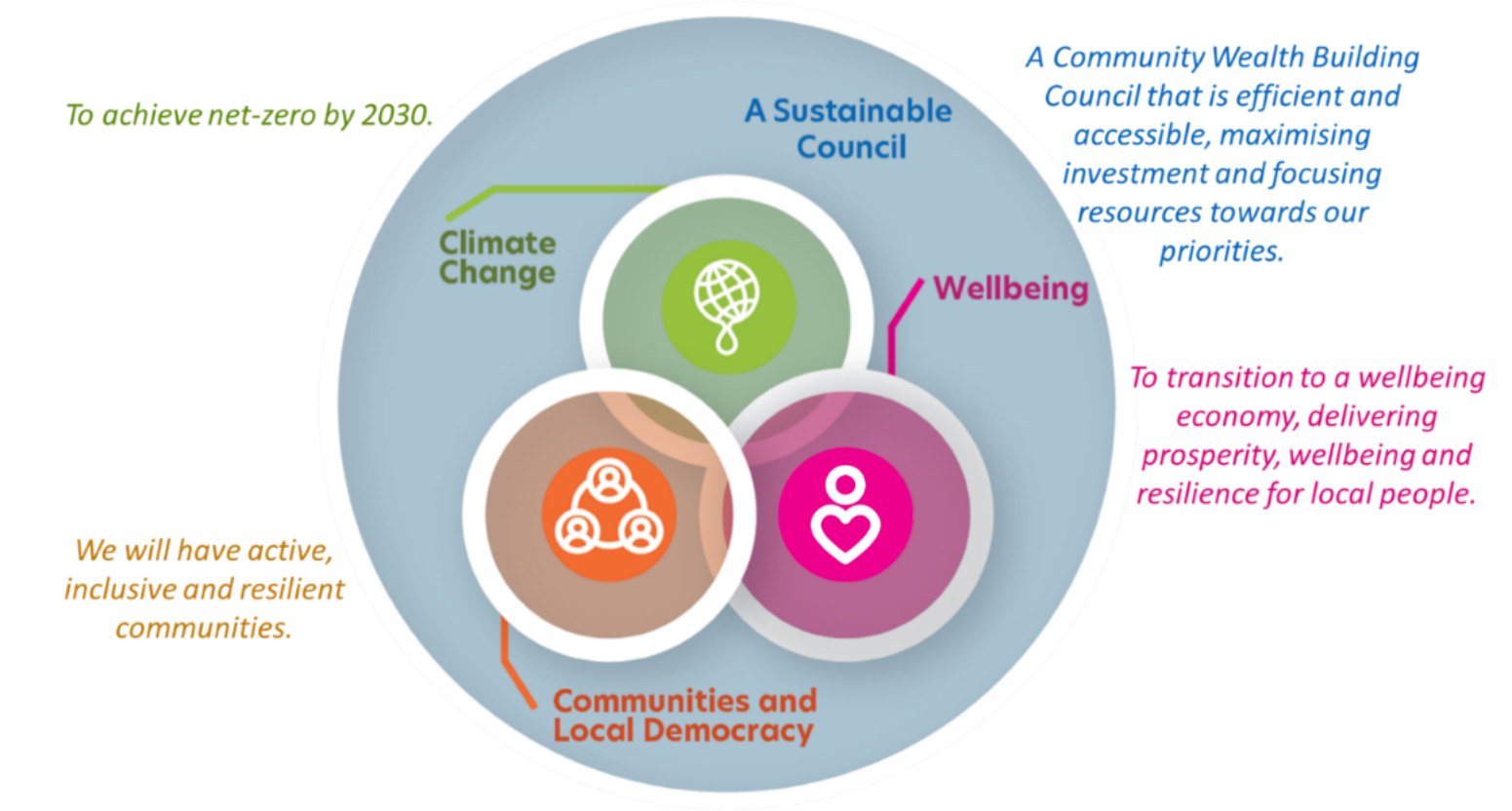
Our Council Plan has four interlinked and interdependent priorities. They are cross service so intentionally do not align to our council directorate structure:
4.3 Operational Plans
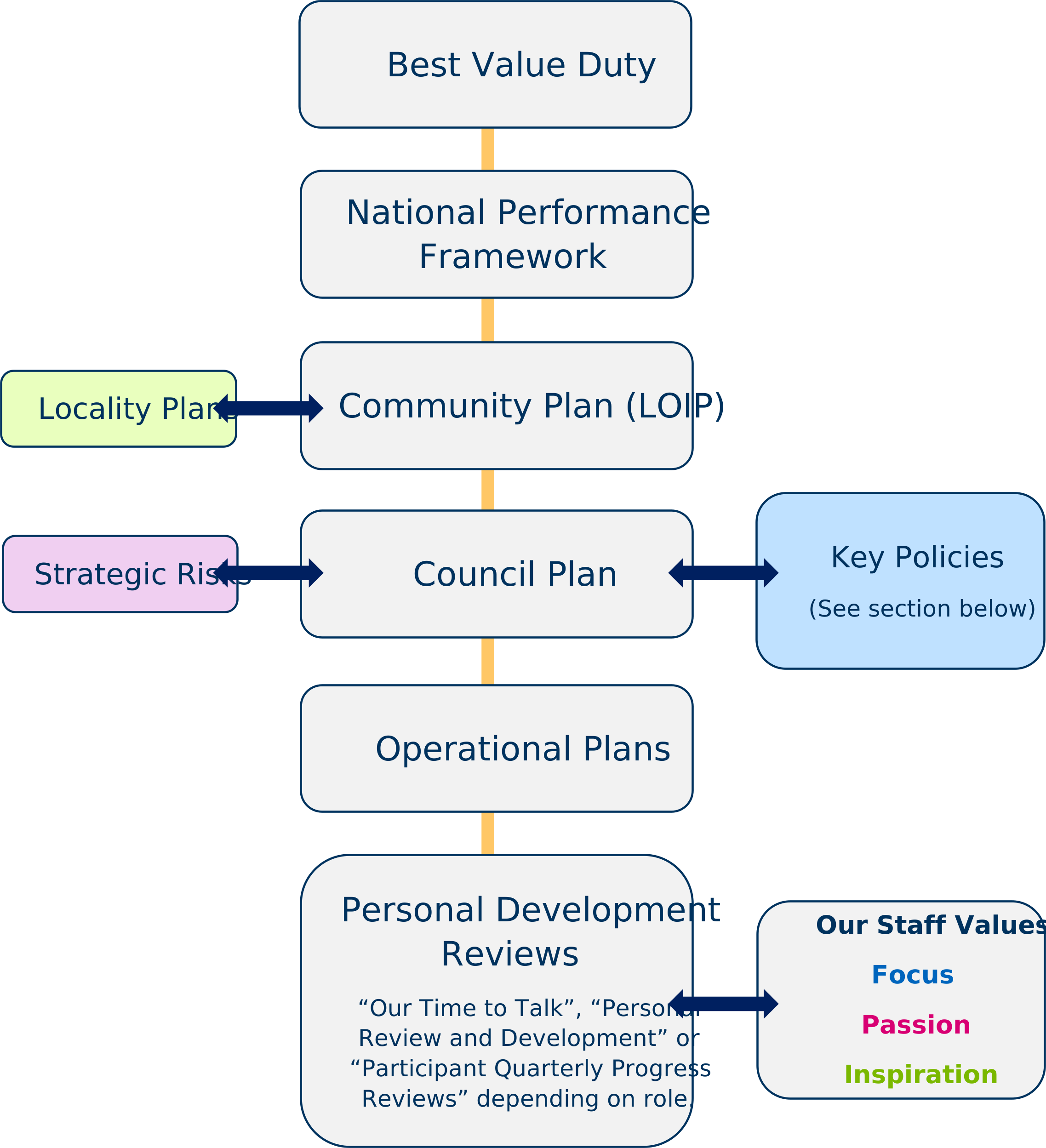
Operational Plans are reported to Heads of Service and Executive Directors. Operational Plans are informed by our priorities but are more detailed and are part of the delivery mechanism of Our Council Plan alongside other council strategies (see The “Golden Thread” – Linear Management of Priorities below). Operational Plans are also crucial in supporting self-assessment.
4.4 Personal Development Reviews
Personal Development Reviews are key to ensuring all employees are aware of how their work contributes to Our Council Plan priorities. They should take place at least once per year in addition to regular discussions about personal and team performance with line managers. Personal Development Reviews are known as ‘Our Time To Talk’ for all non-teaching employees, ‘Personal Review and Development’ for teaching employees and psychologists and ‘Participant Quarterly Progress Reviews’ for Modern Apprentices.
Our Staff Values
Our Staff Values support a culture of continuous improvement by providing key guidance on how employees are expected to approach their activities. They are central to our recruitment and employee development.

4.5 Strategic Risks
We are risk aware, not risk averse. Our council recognises that a certain amount of risk is necessary in order to deliver our priorities. However, we aim to reduce the likelihood and/or impact of risk through effective risk management. This supports decision-making processes, enabling our council to innovate and deliver services more effectively in line with Best Value.
The most significant risks are identified through our Strategic Risk Register. These risks are managed through our Risk Management Strategy. To ensure effective risk management we actively mitigate strategic risks through Our Council Plan and Operational Plans.
5. Maintaining a culture of continuous improvement
5.1 The "Golden Thread" - Linear Management of Priorities
Every task of every employee within our council contributes to achieving better outcomes for the people of North Ayrshire. This link is referred to as the “Golden Thread”. An overview is shown below:
5.2 Priority Leads - Cross Service Management of Priorities
To reinforce the interlinked and interdependent nature of our four Council Plan priorities, we have appointed Executive Directors as Priority Leads. This section explains how this approach reinforces our culture of continuous improvement.
By having oversight both of their Directorates (linear oversight as per the Golden Thread above) and priority (cross-service oversight) this enforces a matrix approach to performance management within our council. The intention is to provide additional oversight and scrutiny of each priority, to identify opportunities for collaborative working, ensure effective and efficient working, as well as enhance and record the cumulative impact of our services in improving the lives of the people we serve to support continuous improvement. Ultimately it is about improving communication, scrutiny, opportunities and outcomes. The priorities have been allocated as follows:
- Wellbeing – Executive Director (Education)
- Communities and Local Democracy - Executive Director (Communities and Housing)
- Climate - Executive Director (Place)
- A Sustainable Council – As this is an enabling priority, management is naturally absorbed into the three other priorities.
The Corporate Policy and Performance Team has aligned resources to this approach to enhance performance management of Our Council Plan and to strengthen our performance arrangements throughout our council.
5.3 The Matrix Approach in Practice
To support the linear and cross service management of priorities, known as the matrix approach, we have established a Priority Framework. This Framework provides a consistent structure within which to promote priorities and realise the benefits of increased communication, scrutiny and opportunities.
Each quarter a Leadership Conference is hosted by the Chief Executive and a Priority Lead (Executive Director) or the Director of the Health and Social Care Partnership.
The purpose is to provide a strategic context to our work, provide case studies (including overlap with other priorities) and gain insights into opportunities available through pooling the knowledge within the room (cross-service).
Attendees are then expected to disseminate this information across their teams (linear).
Approximately four weeks after the Leadership Conference, the Chief Executive and Executive Director provide more detail on the priority and areas discussed at the Leadership Conference. This session is attended by Executive Directors and Heads of Service (cross service).
The purpose is to provide more detail and obtain specific actions to take forward within services (linear) and identify specific collaborative working opportunities (cross service).
This one-hour online session is hosted by the Executive Director or a representative from their service. This training session disseminates findings and actions from the Leadership Conference and COLT to a wider range of employees (cross service).
Personal Development Reviews known as ‘Our Time To Talk’ for all non-teaching employees, ‘Personal Review and Development’ for teaching employees and psychologists and ‘Participant Quarterly Progress Reviews’ for Modern Apprentices, are used to further emphasise the connection between every employee’s role and the ‘bigger picture’ of Our Council Plan priorities and promote our Staff Values of Focus, Passion and Inspiration (linear).
Regular briefings for our Administration are provided by the Priority Leads (Executive Directors), outlining progress so far in delivering our priorities and key future milestones (cross service).
Internal communications are utilised to promote the specific priority during each quarterly period. This includes updates in our internal news bulletins ‘News In Brief’ and ‘Spotlight’. Laptop backgrounds are updated to show the appropriate priority logo. (Cross service.)
As part of the Corporate Communications Plan, case studies are produced and released in our YouTube channel and other social media. These are used within our Council Plan Progress Reporting. Work is ongoing to further align the resources created by Communications to help inform our performance reporting, including embracing a range of media in an accessible way as per the Direction 2024. (Cross service.)
For each priority, the Priority Lead may establish a working group of officers from across our council and partners. The Wellbeing Assurance Oversight Group for example enables a quarterly in-depth analysis of the Wellbeing priority. This includes describing specific work of teams, exploring how this could be further improved through cross service or partnership working, identifying any risks, removing duplication and using this information to inform future services. (Cross service.)
5.4 Key Policies
By encouraging linear and cross-service management of performance, this matrix approach is intended to deliver more holistic services through comprehensive non-siloed policy. Our policy landscape is summarised below:
- Best Value and continuous improvement
- Community Empowerment (Scotland) Act 2015
- Scotland’s Public Service Reform Strategy – Delivery for Scotland
- New Municipalism 2025
- Scotland’s Fiscal Outlook - The Scottish Government’s Medium Term Financial Strategy 2025
- Scottish Government Fiscal Sustainability Delivery Plan
- The Economic Crime and Corporate Transparency Act 2023 (ECCTA)
- Best Start Bright Futures Tackling Child Poverty Plan 2022-26
- The United Nations Convention on the Rights of the Child (Incorporation) (Scotland) Act 2024
- The Promise
- Getting it Right for Every Child (GIRFEC)
- Equality Act 2010
- Human Rights Based Approach
- Fairer Scotland Duty
- Consumer Duty
- Islands (Scotland) Act 2018
- Climate Change (Emissions Reduction Targets) (Scotland) Act 2019 – Net Zero Scotland by 2045
- Placemaking Approach
- National Strategy for Economic Transformation (NSET)
- Green recovery and renewal
- Community Wealth Building Strategy
- The Ayrshire Regional Economic Strategy
- North Ayrshire Partnership Plan (LOIP)
- Locality Plans
- Island Plans
- Health and Social Care Partnership Strategic Plan
- Education Service Improvement Plan
- Child Poverty Action Plan
- Fairer Futures Scotland
- Collaboration for Health Equity in Scotland (CHES) Programme.
- Children’s Services Plan
- Children’s Rights Report
- North Ayrshire Participation Strategy
- Youth Participation and Citizenship Strategy
- North Ayrshire Financial Inclusion Strategy
- Local Development Plan
- Regeneration Delivery Plan
- Local Housing Strategy
- Capital Investment Strategy
- Local Transport and Active Travel Strategy
- Strategic Housing Investment Plan (SHIP)
- Sustainable North Ayrshire Strategy
- Corporate Procurement Strategy
- Workforce Strategy
- Risk Management Strategy
- Digital Strategy
- KA Leisure (North Ayrshire Leisure Limited) Business Plan
5.5 Roles
Everyone is responsible for performance, every task undertaken in the working day contributes to our ‘bigger picture’ outlined by Our Council Plan (as detailed in the sections above). However, roles have specific responsibilities in terms of performance management.
The Accounts Commission is the independent public watchdog for local government, they report directly to our residents.
North Ayrshire Council is responsible for approving Our Council Plan which sets out our vision and direction for five years.
The Audit and Scrutiny Committee has oversight of a range of functions including the preparation of a strategy for performance review; ensuring that Chief Officers establish and implement arrangements for reviewing service performance against objectives; monitoring the performance of our council towards achieving policy objectives and priorities; and reviewing the implementation of Our Council Plan.
Cabinet is the main decision-making body within our council. It is responsible for the setting of the vision and direction of our council, scrutiny of performance and approving the submission of performance reports to the Audit and Scrutiny Committee.
The Executive Leadership Team has strategic responsibility for Our Council Plan, scrutinising performance and agreeing action and resources to address areas of underperformance.
Executive Directors are responsible for the strategic direction of their directorate and ensuring it is inline with Our Council Plan. They have overall responsibility for the performance of their directorate and are directly involved in finalising the priorities and content of Our Council Plan. As Priority Leads, they work collaboratively cross-service to identify opportunities for improvement within their assigned priorities.
Heads of Service are responsible for managing and scrutinising the performance of their teams through Council Plan reporting, Operational Plans and self-assessment. In addition, they scrutinise and approve the release of information to external regulators. They also identify opportunities to learn by benchmarking performance with others (not limited to other local authorities).
The Corporate Policy and Performance Team leads the delivery of the statutory duty to demonstrate Best Value as set out in the Local Government (Scotland) Act 2003. This includes supporting the Executive Leadership Team in the creation, management and reporting of Our Council Plan and other performance frameworks, contributing to national performance networks and collaborating with all teams within our council to achieve continuous improvement.
Managers are responsible for managing the performance of their team and supporting their team to deliver overall objectives in Our Council Plan. In addition, Senior Managers are responsible for Operational Plan creation including setting objectives and targets, self-assessment and may be involved in updating Council Plan performance. They also identify opportunities to learn by benchmarking performance with others (not limited to other local authorities).
We all contribute to Our Council Plan through delivering the tasks agreed in our team plans and personal development reviews. As a result, we all contribute to improving the lives of the people we serve.
5.6 The Continuous Improvement Cycle - Plan, Do, Learn, Act
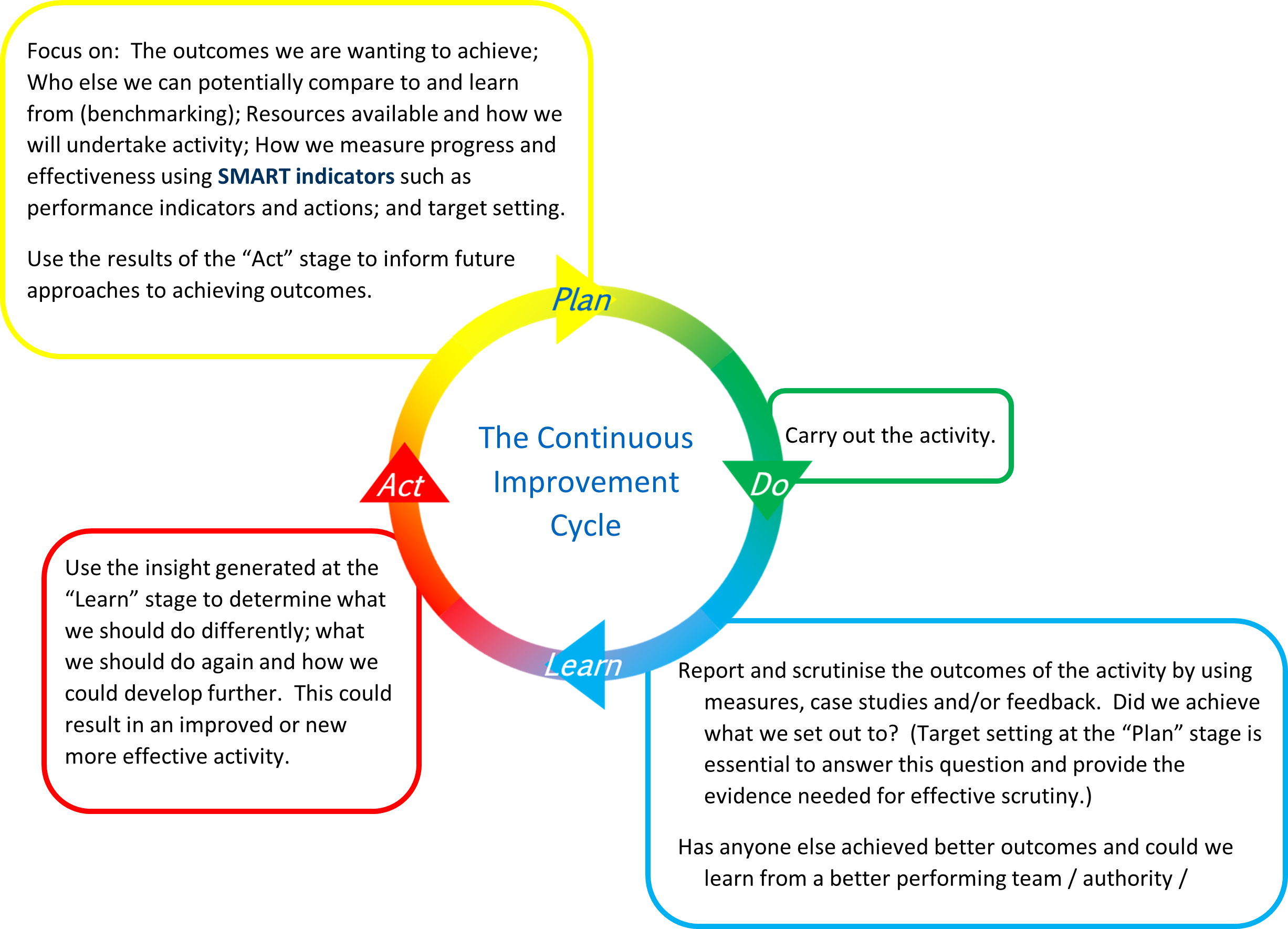
Performance management and performance reporting are very different. Performance management is using the information available to us to effectively plan, undertake activities and learn from the results. We then act on this learning to inform future planning to meet the needs of the people of North Ayrshire. This is known as “The Continuous Improvement Cycle” or “Plan, Do, Learn, Act”.
Performance reporting is a method within the “Learn” part of this cycle to show what has been achieved so progress can be effectively scrutinised and this evidence used to inform our decisions (in the “Act” and “Plan” stages). This could result in improved activity or a new activity that will improve outcomes.
This is a continuous improvement cycle with its complexity and timescales tailored to the strategic level, scale or risk of a plan, project or activity. It is key to effective performance management throughout our council.
For further details on creating performance measures and setting targets to effectively manage performance, please see sections below.
6. Performance reporting and scrutiny
We have a statutory duty under the Local Government in Scotland Act 2003 and Local Government Act 1992 (SPI Direction) to report our performance in a balanced and timeous way. In addition, the process of reporting our performance ensures effective scrutiny by peers, Elected Members and ultimately our residents. This process ensures our performance reporting is balanced, accurate and transparent.
It is essential to support an open and transparent culture whereby should an error be found, the relevant team can contact the Corporate Policy and Performance Team for guidance. There is a process in place to ensure that where an error has been published, any issues and corrections, particularly where a status may be affected, are reported within the next available performance reporting period to Cabinet and The Audit and Scrutiny Committee. Any approved changes are recorded in the notes section of our performance management system for auditing purposes.
6.1 Our Council Plan Performance Management Framework
Within our previous Council Plan 2019 to 2024, sub actions were introduced and sourced from existing strategies. Though intended to strengthen the golden thread between the Council Plan and teams, this resulted in approximately 100 specific actions within our Council Plan making effective scrutiny challenging.
Our Council Plan 2023 to 2028 Performance Management Framework (PMF) takes a more strategic approach, where actions are higher level but mapped to existing strategies, not specific strategy actions. More than one team may be assigned an action to avoid a siloed approach. Relevant teams are then able to provide a fuller update, focussing on the performance of that strategy as well as associated activity. This intends to support more effective scrutiny and cross team working, promoting a whole system approach to our delivery for the benefit of our residents. There are 47 actions within our Council Plan Performance Management Framework, with one of these delivered directly by the Health and Social Care Partnership.
Performance Indicators are also mapped to existing strategies and returns where possible. There are 26 PIs within Our Council Plan, a mix of direct performance and contextual information to enable effective scrutiny. Within these 26 PIs are nine LGBF PIs. These nine LGBF PIs form part of the 33 Priority LGBF PIs (LGBF PIs that directly link to Our Council Plan priorities) which we actively benchmark with similar local authorities (see The Local Government Benchmarking Framework and Benchmarking sections).
Separately from the PMF, we refer to the Wellbeing Economy Dashboard created by our Economic Policy Team. This contains a suite of indicators recording local level data across wellbeing economy themes. Measures are aligned to Our Council Plan for consistency but are not limited to purely council performance. The Wellbeing Economy Dashboard provides essential context to our council’s performance and will be used increasingly as part of performance scrutiny, particularly via Priority Lead work (see Priority Leads – Cross Service Management of Priorities section above).
As part of the previous PMS an extended deadline for updates of three weeks from quarter end was introduced. This was to allow for potential delays due to school holiday periods. However, though initially this was well received, “deadline creep” has been identified. As a result, the two-week deadline for updates has been reinstated. Any requests for an extension must be made in advance of the deadline and will be considered on a case-by-case basis.
6.1.1 Performance Indicators (PIs)
Performance Indicators are viewed as ‘traditional performance’ in that they are numerical measurements of performance used to create charts and benchmark performance over time or with other local authorities and organisations. For Our Council Plan, where practical to do so, PI reporting frequencies are quarterly in addition to annual reporting, with a minimal lead in time where possible. This frequency may vary for supporting strategies and Operational Plans.
There are two main types of PI, output and outcome. Output relates to specific measurements, such as ‘the number of people attending events about democracy’. Outcomes relate to the impact of activity, such as ‘percentage turnout at a local election’. I.e. Output tends to be the foundation activity to support an outcome.
Importantly, measures are only put in place if they are needed on a statutory, strategic or operational basis, i.e. The purpose of information is to actively inform decision making, not because it is possible to measure or it, is something “we have always done” or is “nice to have”. Failure to rationalise what is recorded leads to a high quantity of updates but lower quality as a result, resulting in ineffective scrutiny.
An important note, performance indicators should always be objective and not narrative based. For example, ‘Increased percentage turnout at local elections’ might be an objective, but it is not a measure. The word ‘increased’ needs to be removed in order for it to be measurable and avoid issues during scrutiny. I.e. If the figure decreased over time, yet it was reported as ‘increased percentage turnout’, this would cause significant confusion.
It is also worth considering that not all elements of our work can be distilled into figures, indeed sometimes it is not practical or useful to condense outputs or outcomes into numerical data. Our services and the impact they have on our people of North Ayrshire can be far more complex than this. As a result, all PI updates must be accompanied by a note describing the activity undertaken to achieve that level of performance. Additionally, teams may wish to explore alternative methods of capturing impact (see Creativity and Innovation section below).
SMART Indicators
In summary, the creation of PIs must meet these standards:
- Specific – Precise in what we are trying to measure.
- Measurable – Realistic in terms of how we can measure the indicator and how practical it is to source this data when needed. If the effort of sourcing the data outweighs its value, then an alternative measure could be a better choice. How a PI is measured including source data should be described and saved on file.
- Achievable – Ambitious but realistic targets.
- Relevant – The measure relates to our priorities, will tell us what we need to know to make a decision and relates to the overall aim.
- Time-bound – There are timeframes for achieving goals.
It is important to make a distinction between SMART indicators and other sources of information such as real lived experiences which are invaluable in informing policy and demonstrating impact. A blend of PIs, actions and real lived experience is essential to inform decision making.
Targets
Where possible, targets should always be set for at least the next financial year and quarterly if possible. Sometimes it is not appropriate or ethical to set targets for some indicators and trends are used to determine whether performance is improving. This is however the exception rather than the rule. Reasons for lack of a target may include a new indicator (meaning there is no historical data to base a target decision on), fluctuating operating environment and some wellbeing related indicators. Where a target is intentionally not set, this indicator is set as “data only” within our performance management system.
Targets may be based on statutory criteria, historic trends, percentage increases related to a similar percentage increase in resources, benchmarking and stretch targets. (Stretch targets are very challenging yet achievable targets given the ideal environment.) A method of judging whether a target is appropriate is by asking “if our services didn’t reach a particular figure, would this cause concern/result in action being taken somehow?” If so, adjust the target to the point where it is challenging but achievable, yet if it is not reached that status would inform a decision.
As we are committed to continuous improvement through the Best Value legislation, ideally improvement would be shown each year in increasing trends (or decreasing trends if it is an area we wish to minimise such as CO2e Emissions). However, the operating environment must be considered as sometimes maintaining performance shows considerable improvement. In such cases, context within the notes is essential.
Determining the Status of a Performance Indicator
The performance status is also known as RAG status due to colour coding used to show progress (red, amber or green). Within our performance reporting the status of a PI or action is determined as follows:
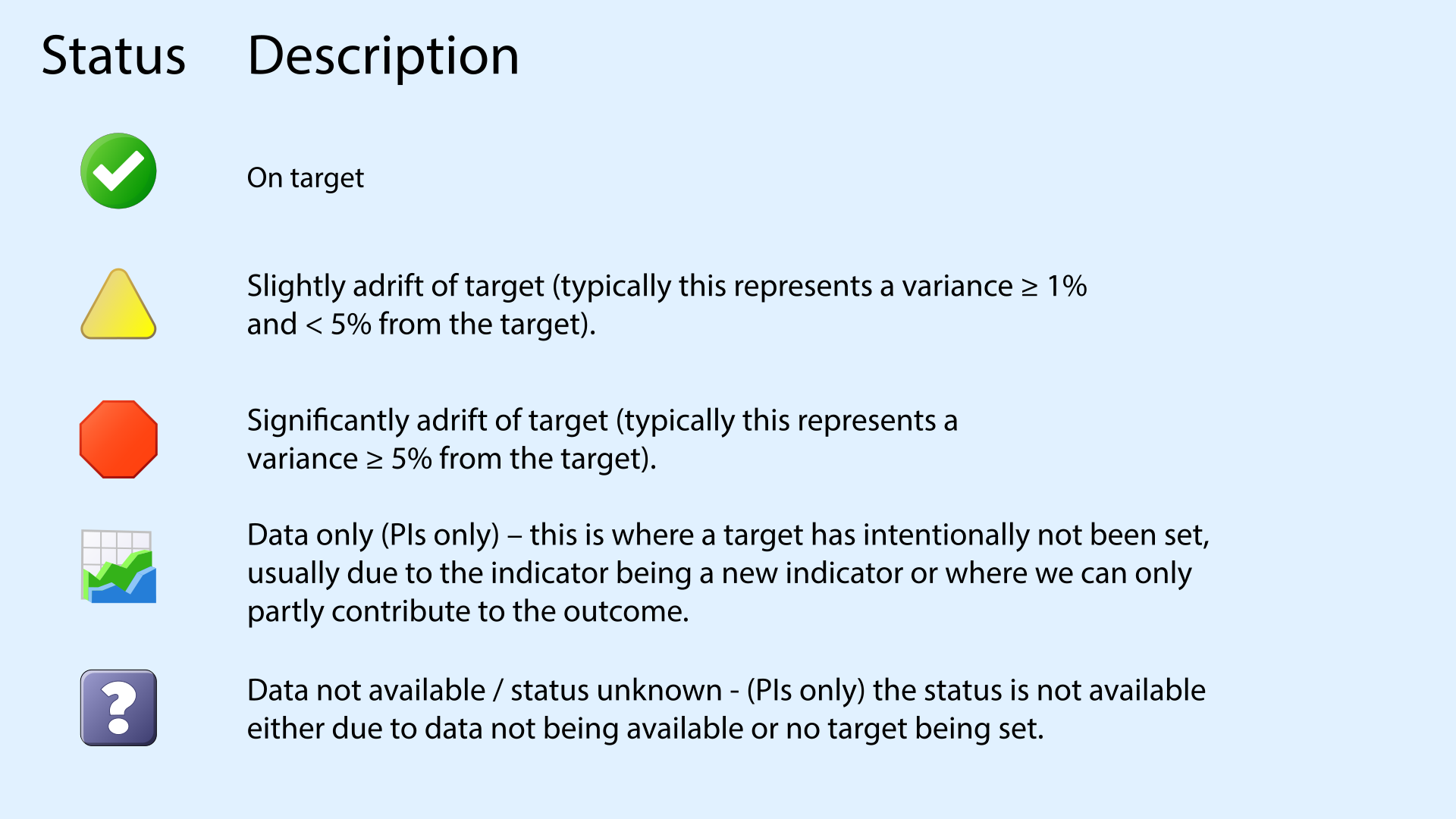
Where a PI is adrift of target, as per the Direction 2024, reasons for this status and how this will be addressed including a timescale for this to be resolved must be included in the PI update and recorded within the performance management system and Council Plan reporting.
When calculating the percentage of indicators with each status for a period within covering reports, the most recent available status is used up to the previous financial year end. For example, Quarter Two 2023 to 2024 uses statuses up to 31st March 2023. This ensures any data with a time lag is reported, yet information older than this is given the status of “data not available” for this calculation to ensure past performance does not impact on the scrutiny of current performance.
Indicators set as data only or with no data available are excluded. For example:

Positive and negative trends are shown within our reporting. In terms of Our Council Plan these are defined as:
- Short-term Trend: Comparison with previous year (two data points).
- Medium-term Trend: Comparison with three years previously (four data points).
- Long -term Trend: Comparison with more than three years previously (minimum five data points).
Performance Indicator Information Sheets (Meta data)
To ensure the consistency and robustness of our data, PI Information Sheets are produced for all the PIs within Our Council Plan. This includes information such as an explanation of why the indicator is useful to measure, the methodology for the calculation of the PI, source material, rationale for the targets set and any other comments as necessary. For national returns, such as the Local Government Benchmarking Framework (LGBF) the metadata (which outlines the calculation methodology) from the requestor (Improvement Service) is cross referenced within the information sheets with any additional information added.
All sheets are signed by the Senior Manager responsible for providing the information, stored corporately and uploaded to our performance management system / intranet pages for ease of reference.
This approach will be encouraged for all strategies across our council for audit purposes, to support reasonable procedures relating to The Economic Crime and Corporate Transparency Act 2023 (see Failure to Prevent Fraud Corporate Offence above).
Ensuring Transparency
On the rare occasion the Corporate Policy and Performance Team is notified of a historical error in the data or targets held, the corrections are presented to ELT, Cabinet and the Audit and Scrutiny Committee for full transparency and noting as part of the next cycle of Council Plan reporting. For clarity, targets will not be amended if the time period has passed or is in progress to prevent any perceived influence on the status. The only exception to this is where the target has been publicly published elsewhere prior to the reporting period and previously approved by Cabinet. Any amendment must be accompanied with an explanation for the error, details of prior publication and approval if relevant and steps being taken to prevent it happening in future.
Creativity and Innovation
Creativity and innovation is welcomed when considering how to show information in a robust and objective way to enable scrutiny. There are two elements to this: Information and presentation. This is crucial as performance management depends on clear communication of accurate and relevant information (at the right time). Effective presentation methods vary depending on the complexity of data, information available, audience, accessibility and media used.
One of the greatest challenges within performance is to demonstrate the cumulative impact of our work, particularly when considering a person-centred approach. Case studies and real lived experience can be very powerful and informative. However, to capture then benchmark cumulative impact with others/over time to show continuous improvement can be very difficult.
Creativity can be used to present information in a holistic way - considering a complex area such as child poverty for example. To determine the cumulative impact on a person or family, services may explore developing profiles based on the six priority families (families identified by the Scottish Government as being at most risk of experiencing poverty). These profiles can then be used to discover what support and benefits they may be entitled to, from clothing grants to employability support, in the same way any family contacting our council would be supported. This same family can be ‘frozen in time’ and used to calculate this information in past and future years, creating trend data and helping to identify any gaps in provision. Going a step further, it could be used to benchmark against provision in other areas, resources allowing. This information could then be presented visually to encourage scrutiny but also encourage families to relate to them and contact our council and partners for support.

Alternatively, where a particular area is difficult to measure, proxy measures can be introduced to measure the secondary impact of activity. I.e. If it’s not possible to measure the core issue, related elements surrounding it can be measured and collated. This in itself can produce meaningful evidence to drive decision making.
Various methods can be explored and piloted. A note of caution, the impact on our people must never be distilled into numerical measures alone; a range of different categories of information is essential.
6.1.2 Actions
How actions are written fundamentally affects the quality of performance scrutiny. Actions are narrative updates (not numerical), an explanation on the activities being undertaken to deliver our priorities, supported by a red (significantly adrift of target), amber (slightly adrift of target) or green (on target) RAG (red, amber, green) status. However, they are very much based on evidence and the statuses can be used to create a trend of performance over time. Ideally every action should be linked to a performance indicator to provide full context and further evidence of performance.
Confusion often arises in terms of whether ‘business as usual’ actions should be included within strategic and Operational Plans. Our council approaches this differently and includes actions based on their relevance to our priorities and associated risk. An action is included as long as it relates to our priorities and needs to be actively managed if it impacts on any of the following categories:
- Statutory obligations
- Our residents, visitors or businesses
- Finances or other resources
- Corporate risks (all levels)
- Reputational risk (which could impact future resources)
This approach helps to inform the status of an action as detailed in the ‘Determining the Status of an Action’ section below.
SMART Actions
Similar to PIs, the creation of actions must meet these standards:
- Specific – Precise in what we are trying to measure. It is important to determine ”what success looks like”.
- Measurable – Measuring actions is usually based on milestones, key moments in the action’s timeframe when specific outputs can be evidenced. Linking to PIs is recommended in this situation to strengthen the information if possible, however other outputs may be project stages, the ground breaking ceremony of a new build, engagement sessions being held etc. and may not lend themselves to being PIs as a result.
- Achievable – Ambitious but realistic.
- Relevant – The measure relates to our priorities, will tell us what we need to know to make a decision and relates to the overall aim.
- Time-bound – All actions have a completion date.
Timescales
Traditionally corporate performance management and reporting coincided with financial years, however with long-term developments such as the Ayrshire Growth Deal as well as recognising that some services, such as Education, work to different reporting frequencies and timescales such as academic years, this was reviewed as part of our previous strategy.
In April 2021 we introduced a more dynamic form of performance management that reflects the activity rather than the financial or academic year. This ensures:
- Education performance is captured using term time frequencies and academic years where appropriate within our corporate reporting. (I.e. Academic year end is captured in Quarter Two / Mid-Year Council Plan reporting.)
- Large scale projects are reported at a level where the full project, milestones or relevant project stages are reported – preserving the context, project governance and providing a holistic view of performance and impact.
As actions for specific areas end, potential replacement actions are identified if appropriate. These are approved by the Executive Leadership Team and Cabinet when Council Plan performance is presented for scrutiny and approval (at Quarters Two and Four). Rationale for any replacement actions is based on Council Plan priorities, performance and operating environment rather than like for like replacements (‘The Continuous Improvement Cycle - Plan Do Learn Act’ above).
Our Council Plan Annual Performance Report remains aligned to financial years and captures all performance progress within that year. It cross references to the more detailed six-monthly Council Plan Progress Reports and LGBF reporting.
Determining the Status of an Action
Actions provide an update on planned activity over a certain time period. For this reason, action updates are explanations of performance, including what is going well and, if an activity is behind schedule, what is being done to address this and when this will be resolved by.
The actions within Our Council Plan summarise activity undertaken through existing key strategies.
The status of an action is determined by considering “what success looks like” and the following:
1. If the action has not yet reached its due date, an informed decision is made by the action owner on whether they consider the action to be on target, slightly adrift or significantly adrift of where it should be at that time. This can be informed by the following, however teams must provide early identification of issues to allow early intervention:
2. Only when no concerns are raised regarding the above elements can an action be stated as being on target (green). If concerns are raised, whether an action is amber or red can be determined as follows:
3. If an action is not complete at its due date, it is automatically set as significantly adrift of target. Due dates can only be extended where there is a reasonable explanation to do so. The proposed amended timescales are then presented to Cabinet for full transparency and approval and do not take effect until after Cabinet approval including the associated call-in period elapsing.
Where it is not appropriate to continue with an action due to changes in expected benefits, withdrawal of resources, being superseded by other activities, external issues or lack of business justification, it is possible to set an action as “Off Programme”. Guidance must be sought from the Corporate Policy and Performance Team and this status is subject to ELT and Cabinet approval.
The above process is designed to be comprehensive to enable specific status decision making across each individual Council Plan action. This crucially supports a transparent manage by exception approach, enabling the ELT to scrutinise effectively based on appropriate information (whether positive or negative). This in turn gives early intervention opportunities to support services and senior teams to deliver the outcomes of Our Council Plan.
As we utilise the matrix approach through linear and cross-service priority management of our priorities (detailed above), the options available for intervention via the ELT can be cross-service and more impactful. This is why transparent reporting and early intervention is essential.
Presenting the Action Status
The status of an action is recorded as significantly adrift (red), slightly adrift (amber) or on target (green) (RAG status) using this option in the performance management system. Though functionality to track actions though percentage complete exists, this is not an effective method of scrutiny as percentage complete figures need to be profiled across the action timescale, is independent of RAG status and can cause confusion and distraction during scrutiny due to the complexity of delivery. I.e. Some activity is “front loaded” so more intense initially, others have a more intense delivery towards the end of the action timescale – it is rarely linear.
Where an action is adrift of target, as per the Direction 2024, reasons for this status and how this will be addressed including a timescale for this to be resolved must be included in action updates and recorded within the performance management system and Council Plan reporting.
Actions form the basis of the narrative within the six-monthly Council Plan Progress Reports. A visual Action Status Tracker is included in the reports to enable any action trends to be identified.
6.1.3 Case Studies
As per the Creativity and Innovation section above, case studies are essential to demonstrate impact and prevent performance reporting from becoming isolated from the people we serve. Case studies should follow the STARL approach:
- Situation – Explain the context of the situation and issues or challenges being experienced.
- Task – Describe why these issues or challenges needed to be addressed.
- Action – What was done to address these issues and challenges.
- Result – The outcome of this activity, what changed as a result and how is this ideally going to be sustained over the longer term.
- Learn – The learning that has been captured to inform any future approaches.
Ensuring the voices of our people are included in our performance reporting is extremely important.
6.2 Council Plan Progress Reports
The following process is followed for the creation and scrutiny of our statutory Council Plan progress reporting:
- Updates added to our performance management system, a secure and auditable corporate system. Updates need to be approved by Senior Managers prior to being entered in the system and must align to any PI information sheets and metadata.
- Secondary data checks regarding consistency with previous reporting, PI metadata and resulting constructive challenges are undertaken by the Corporate Policy and Performance Team.
- Reports are drafted by the Corporate Policy and Performance Team.
- For the large six-monthly reports at Q2 and Q4, these are reviewed by Heads of Service. Data continues to be checked following review.
- Report is finalised in terms of cross referencing and ensuring it is accessible (both technical and non-technical).
- The large six-monthly reports are considered by the Executive Leadership Team in a dedicated 90 minute session. The smaller Q1 and Q3 reports are considered as part of the main ELT agendas. During this scrutiny, discussions take place regarding the information and potential opportunities for improvement including working across services.
- Any additional information such as enhanced next steps (including timescales) are added, the report is finalised.
- The report is considered by Cabinet. Chief and Senior Officers attend to answer specific questions regarding performance in their areas.
- Following the call-in period, the report is published on our website, supported by internal and external communications.
- Following approval by Cabinet, the report is scrutinised by The Audit and Scrutiny Committee. Chief and Senior Officers attend to answer specific questions regarding performance in their areas.
In addition, there is a significant amount of data checking, ensuring notes explain performance and provide context, sourcing qualitative information around the impact we are having such as case studies and ensuring our reports are accessible and relevant to the people of North Ayrshire.
As a result, effective time management is crucial to ensure reports are scrutinised and in the public domain while the data is still as relevant as possible.
We will improve how our reporting is published both within our council and externally through working with our Communications team to develop a regular schedule. We will review our webpages and ensure all information is relevant and timeous.
6.3 Scrutiny of Reporting
Scrutiny of performance takes account of all performance, not only focussing on adrift of target areas. Scrutiny training is available on request from the Corporate Policy and Performance Team and all Elected Members attend Scrutiny training as part of their induction.
6.4 Schedule of Corporate Reporting
Quarter 1
April to June.
Light touch summary presented to the Executive Leadership Team.
Quarter 2
July to September.
Full six-monthly progress report produced for scrutiny by the Executive Leadership Team, Cabinet and the Audit and Scrutiny Committee.
Published on our website.
Quarter 3
October to December.
Light touch summary presented to the Executive Leadership Team.
Quarter 4
January to March.
Full six-monthly progress report produced for scrutiny by the Executive Leadership Team, Cabinet and the Audit and Scrutiny Committee.
Published on our website.
Annual
Full year Annual Performance Report produced for scrutiny by the Executive Leadership Team, Cabinet and the Audit and Scrutiny Committee.
Published on our website.
Public facing North Ayrshire Performance Dashboard updated.
Quarter 1
April to June.
Priority LGBF indicators released during the Quarter are included in the light touch report.
Quarter 2
July to September.
Priority LGBF indicators released during Quarter 1 and Quarter 2 are included in the six-monthly report.
Quarter 3
October to December.
Priority LGBF indicators released during the Quarter are included in the light touch report.
Quarter 4
January to March.
See Annual below.
Annual
LGBF report produced for scrutiny by the Executive Leadership Team, Cabinet and the Audit and Scrutiny Committee.
Published on our website.
Operational Plans are supported by the Corporate Policy and Performance Team. They are reported within Services and Directorates.
6.5 Accessibility
Our performance reporting is written for our residents to enable them to engage with and effectively scrutinise our performance. Accessibility in terms of the Direction relates to the information being engaging and easily understood (referred to in the guidance as “non-technical”) and accessible in terms of equality legislation (“technical”). The Accounts Commission recognises the challenges when presenting performance information
"…there is a need to strike a balance, for example:
- In summarising information without presenting an incomplete or distorted representation of performance, and
- In displaying information in a graphical or interactive format without disadvantaging or excluding people with visual or cognitive impairments.” (Direction 2024 Guidance for Local Authorities.)"
The use of technology while adhering to statutory requirements relating to equalities is encouraged.
On 2nd September 2025, Cabinet agreed to note “Cabinet approval relates to the content of the report, not the layout or media used to ensure future flexibility for production of accessible format reports.” This is to enable reproduction of our reporting in a range of formats to reach as many of our residents as possible and ensure we meet both equality legislation and Direction requirements. This includes but is not limited to:
- HTML versions of our reporting on our website (with embedded case study videos).
- Performance Dashboards hosted in Power BI.
- Child Friendly Reporting, with the intention to focus on the 2025 to 2026 Annual Performance Report.
6.6 Council Plan Progress Report Next Steps
Next Steps are included within the six-monthly Council Plan progress reports. These are either significant milestones expected to be reached during the delivery of Council Plan actions or remedial action to bring an activity back on target. Following an Audit Scotland recommendation in our Annual Audit 2024 to 2025, next steps will include specific timescales for completion, rather than stating within the next six months. These will also be tracked within our corporate performance management system for full transparency.
7. Audits, inspections, accreditations and community engagement
Best Value Thematic Audits are reported as part of our Annual Audit and presented to the Audit and Scrutiny Committee each autumn. As Best Value is a statutory requirement which our performance reporting illustrates in line with the Direction 2024, updates are also included within the six-monthly Council Plan Progress Reports. Additionally, where Audit Scotland recommends additional areas to be included in our six-monthly reports as a result of an audit this is absorbed into the reporting. Most recently this includes progress on our Workforce Strategy and Transformation programme.
8. Benchmarking
Benchmarking is comparing our performance to others (it can be wider than the public sector and UK) and learning how to improve as a result. This is not limited to comparing performance indicators, we actively benchmark by comparing different approaches to address the same issue or achieve similar outcomes.
We are one of 32 Scottish local authorities utilising the Local Government Benchmarking Framework (LGBF), coordinated by the Improvement Service and SOLACE. This framework enables us to compare our performance with other local authorities in Scotland across a wide range of themes. In addition, to provide as close a comparison as possible, councils with similar traits are grouped into “family groups”. This gives us access to a wide range of comparable data on as close to a like for like basis as possible.
In 2024 to 2025, the Improvement Service confirmed LGBF family groups are fluid and may change depending on the nature of the information being published. For consistency, we align to the family groups as published within the LGBF online tool/dashboard. Further details on the LGBF can be found above.
We compare performance through several routes, many of which are specialised such as APSE. An overview can be found within page 14 of the Scottish Local Government Assurance and Improvement Framework.
Numerical analysis is useful however the next step, where we use this information to further research or approach other local authorities or organisations to learn what is driving their results, provides much more useful qualitative information and is encouraged.
As with all performance information, benchmarking should be used to drive decisions on future approaches in line with Our Council Plan priorities.
8.1 Verification of External Returns
Benchmarking effectively relies on accurate data within our external returns. The LGBF is the main data return administered corporately. Due to the scale of returns required from our council (see Local Government Data Platform section above) other returns are administered via the relevant service. Though the LGBF sources a substantial amount of data from other external returns, an annual data return is provided by every local authority in Scotland in August. The procedure for LGBF data is:
- If any changes in the metadata, which shows how measures are calculated, are received during the year, these are shared immediately with the relevant services.
- Data from the previous year and a request for the current year are sent to relevant services alongside links to metadata documents.
- Data is received alongside supporting context and scrutinised. If there is a considerable difference between the previous year, or if the data doesn’t seem to reflect narrative within the context provided or recent performance reporting, the service is asked for clarification and metadata documents are reshared. If there is still confusion, Corporate Policy and Performance will meet with the service. Following clarifications, the data is confirmed via email.
- Once finalised, the data is shared with the relevant Head of Service for approval before it is collated and shared with the Improvement Service (who administer the LGBF).
- Where a change to previous figures has been highlighted, this is investigated further to determine the time period a change or error relates to and whether any related time periods or indicators are affected. This information is sought, scrutinised as above and shared with the Head of Service for approval before sharing with the Improvement Service.
- Any errors in previous submissions corrected as per step 5 above, are noted within the next performance reporting period for transparency at ELT, Cabinet and the Audit and Scrutiny Committee. The intention is to highlight the reasons for issues and any resolution identified to learning and prevent it reoccurring.
9. Self-Assessment
Self-assessment is a technique used by organisations to learn where they are performing well, identify opportunities and risks, as well as where improvements are needed. For councils, the focus should always be on using this information to improve our services for the benefit of our residents. The resulting self-awareness is critical to operate effectively.
Contrary to some views, self-assessment is not purely an internal process. It is the foundation of effective scrutiny and as such informs external audits and some accreditations. Nationally the focus on self-assessment is increasing, particularly with the SPI Direction 2024 and work ongoing via the Recommitment to Crerar project. It is a requirement under the Direction for self-assessment results and associated action to be published on our website to encourage scrutiny.
There are many forms of self-assessment and not all follow established tools such as the European Foundation of Quality Management (EFQM) or Public Service Improvement Framework (PSIF). Consideration of performance, human resources information, impact on our residents, complaints and compliment details can often be looked at holistically during quarterly review meetings (sometimes referred to as a ‘balanced scorecard’) and are a form of self-assessment. The issue with having such a varied approach to self-assessment means it is difficult to amalgamate results across services and create a strategic view of performance, identifying any concerns or patterns early. This is why we are improving to adopt a consistent but flexible approach.
To reiterate, self-assessment is a way of initiating improvement and is part of a continuous review of a performance journey, not the destination (see The Continuous Improvement Cycle - Plan Do Learn Act above). As such, all self-assessment should result in planned improvement activity, managed through Operational or other plans.
9.1 PSIF
The Improvement Service is responsible for the development of the Public Service Improvement Framework (PSIF). This is the public sector version of the internationally recognised European Foundation in Quality Management (EFQM) approach. The Improvement Service has recognised the need for tailored self-assessment, rather than the large resource intensive council-wide reviews that took place in previous years. As a result, they have been developing checklists since approximately 2020 for Frontline Services and more recently the Culture Checklist, to assess the culture of an organisation. The “full” PSIF can be tailored to fit the needs of a local authority, enabling further scrutiny of priority areas.
Importantly the Improvement Service offers a training/mentoring service to support local authorities to embed the PSIF in their performance management.
The Public Services Improvement Framework (PSIF) tailored to teams and services will be our main self-assessment tool within our council. We will work with the Improvement Service to initiate the approach. Key principles will be:
- Use of PSIF tailored to risks and capacity of teams and services.
- Reporting to a ‘peer review’ group consisting of members of the Executive Leadership Team to invite scrutiny and inform resource allocation.
- Reporting summaries on our website and within Council Plan progress reports as appropriate.
Information used to inform the assessment will include:
- Local Government Benchmarking Framework priority indicators.
- PSIF self-assessment questionnaire.
- Recent audits, inspections and accreditations (the Scottish Local Government Assurance and Improvement Framework will be referenced).
- Operational Plans (service outputs and outcomes including benchmarking opportunities).
- People statistics such as employee absence, additional costs, health and safety, complaint handling, compliments, request response times (for example Elected Member, MP and MSP requests, FOIs etc.) to gain a full understanding of the performance and ‘health’ of a team (balanced scorecard).
- Financial management.
- Reputational management (communications and consultations).
- Discussion of results with Senior Manager and Head of Service prior to peer review.
This is in addition to scrutiny provided through public consultations and self-assessment of committees.
The PSIF is expected to be consistent with the National Framework for Self-Assessment (NFSA) due to be introduced in early 2026. Though significant overlap is expected, SOLACE and the Improvement Service insist this will not result in duplication, only non-assessed elements of performance would be explored when utilising the NFSA.
By utilising the PSIF consistently across teams, we can identify any strengths or weaknesses at team level. Then, as it is a structured approach repeated across teams, we can identify any recurring themes across services which will help identify patterns and inform a strategic view of performance across our council. Once the NFSA is published, this could be considered as a future alternative.
9.2 Peer Review
Peer review follows self-assessment and is where other teams or services are invited to scrutinise the results of self-assessment when required and make recommendations for improvement.
At a national level and within the SPI Direction 2024, it is known as ‘Peer Collaborative Improvement’ where peers are other local authorities invited to scrutinise performance as required via a formal process led by the Improvement Service. The results and recommendations are then published on our council and the Improvement Service’s websites.
10. Systems
10.1 Pentana Risk
Pentana Risk is our corporate performance management system. We engage with services to improve how we use Pentana to support effective and timeous updates of performance information.
Deadlines for the year are published in our Pentana homepage alongside information on additional support as well as links to Cabinet approved Council Plan progress reports to help strengthen the reporting cycle.
We continue enhance our use of portals (online viewing) to:
- Ensure users can view their own Council Plan actions and PIs, so there is a clear definition between statutory Council Plan measures and internal reporting.
- Enable teams to run Operational Plan reports on demand as required, providing greater flexibility for scrutiny of non-corporate performance within teams.
We will continue to ensure corporately reported data is hosted centrally where appropriate. However, we understand other systems are in use for valid reasons. Therefore, where information is held in an appropriate auditable system there is no need for the data to be transferred / duplicated onto Pentana Risk other than for Corporate Reporting such as Our Council Plan or North Ayrshire Community Plan (LOIP).
We continue to ensure our performance management systems across our council are supporting rather than defining our performance management approach.
10.2 Power BI
We will continue to use Power BI to provide greater insights from the data held by our council. This includes LGBF analysis and the North Ayrshire Performance Dashboard.
11. Action Plan
The following actions and associated PIs are reported as part of the Policy, Performance and Democracy Operational Plan.
A Sustainable Council
Action code: PPD-PMS-01
Action title
Support Executive Directors in the leadership of our Council Plan priorities, including closer working with Communications to develop integrated case studies.
Related Strategy/Legislation
- Council Plan
- Performance Management Strategy
End date
Ongoing
Assigned to
Senior Manager, Policy, Performance and Democracy
What success looks like
- Embedded culture of collaborative working across services to deliver priorities.
- Impact is more fully captured within performance reporting enabling more effective scrutiny.
Links to relevant areas within the Performance Strategy
- Best Value
- Maintaining a Culture of Continuous Improvement
Action code: PPD-PMS-02
Action title
Explore and initiate self-assessment approach to drive improvement and inform budget decisions in line with the SPI Direction 2024.
Related Strategy/Legislation
Statutory/Performance Management Strategy
End date
31 March 2026
Assigned to
Corporate Policy and Performance
What success looks like
- A rolling programme of self-assessment, using risk to prioritise services and tailor the approach and benchmarking to learn from others.
- Priority will be determined by corporate risks, impact on our people (including ECRIAs), financial and reputational risk, LGBF, assessments and accreditations (based on results and how recently they were completed).
- Peer review is undertaken only when necessary.
Links to relevant areas within the Performance Strategy
Self-Assessment
Action code: PPD-PMS-03
Action title
Launch new public Performance Dashboard.
Related Strategy/Legislation
- Annual Audit Action
- Performance Management Strategy
End date
31 March 2026
Assigned to
Corporate Policy and Performance
What success looks like
Council Plan performance information is available on our website via an interactive Power BI dashboard. Data refreshes annually following Cabinet approval and call-in period.
Links to relevant areas within the Performance Strategy
- Statutory Performance Information Direction 2024
- Performance Reporting and Scrutiny
- Systems
Action code: PPD-PMS-04
Action title
Produce HTML versions of Council Plan Progress reports and explore embedding videos.
Related Strategy/Legislation
- Transformation Audit Action
- Performance Management Strategy
End date
30 September 2026
Assigned to
Corporate Policy and Performance
What success looks like
- Performance Reports are presented in engaging HTML format on our website. Videos are embedded. Views of our report pages increase.
- PI: Total number of views of our public facing Council Plan Performance web page.
Links to relevant areas within the Performance Strategy
- Statutory Performance Information Direction 2024
- Performance Reporting and Scrutiny
Action code: PPD-PMS-05
Action title
Include SMART Next Steps in Council Plan progress reports and review / enforce guidance on determining the status of actions in the Council Plan.
Related Strategy/Legislation
- Annual Audit Action
- Performance Management Strategy
End date
20 November 2025
Assigned to
Corporate Policy and Performance
What success looks like
SMART Next Steps are used alongside the Performance Management Strategy guidance and training to support Senior Managers in determining the status of actions in a methodical and transparent way.
Links to relevant areas within the Performance Strategy
- Statutory Performance Information Direction 2024
- Performance Reporting and Scrutiny
Action code: PPD-PMS-06
Action title
Develop and implement council-wide performance management training, in person and online.
Related Strategy/Legislation
Performance Management Strategy
End date
31 March 2026
Assigned to
Corporate Policy and Performance
What success looks like
- Mandatory performance training is available online for all employees. In depth performance management training for Middle and Senior Managers is shared through the Connected Leadership programme.
- Performance Management Strategy is the central reference for council performance.
Links to relevant areas within the Performance Strategy
- Best Value
- Failure to Prevent Fraud Corporate Offence
Action code: PPD-PMS-07
Action title
Refresh performance management framework across our council, working closely with Directorates to enhance Operational Plans and quality of reporting.
Related Strategy/Legislation
Performance Management Strategy
End date
31 March 2027
Assigned to
Corporate Policy and Performance
What success looks like
- Established structure of Operational Plans across all services with quarterly performance review meetings held by all Heads of Service.
- Performance updates are high quality leading to reduced lead in times for corporate reporting.
- PI: Average number of calendar days between six monthly reporting quarter end and reports presented to Cabinet.
Links to relevant areas within the Performance Strategy
Maintaining a Culture of Continuous Improvement.
Action code: PPD-PMS-08
Action title
Develop the next Council Plan for 2028 onwards.
Related Strategy/Legislation
Best Value
End date
31 March 2028
Assigned to
Senior Manager, Policy, Performance and Democracy
What success looks like
- An evidence-based Council Plan focussed on improving the lives of our people in North Ayrshire with Best Value at its core.
- The Plan is aligned to the priorities of our residents, Partnership Plan, national policy, resources, opportunities and risks.
- It is supported by a robust performance management framework enabling in-depth and transparent scrutiny. Methods to determine the overall impact of our work are established.
Links to relevant areas within the Performance Strategy
- Best Value
- A programme of self-assessment took place during summer/autumn 2024 under the title ‘Locality Planning 2.0’. This received feedback from representatives showing members of the locality partnership felt a high level of involvement and ownership of the partnership. Potential areas for improvement, particularly around meetings, were highlighted and will be taken forward as appropriate. A report on the assessment was approved by Cabinet in May 2025.
- Our Council Plan 2023 to 2028
Action code: PPD-PMS-09
Action title
Explore potential cost effective alternatives to current performance management system, liaising with other local authorities and procurement to determine options, costs, frameworks available and associated lead in times to embed a new system.
Related Strategy/Legislation
Performance Management Strategy
End date
31 January 2026
Assigned to
Corporate Policy and Performance
What success looks like
A cost-effective performance management system that continues to be secure, supports effective scrutiny of all corporate strategies, service led strategies, Operational Plans and risks while ensuring all elements are auditable.
Links to relevant areas within the Performance Strategy
Systems
Action code: PPD-PMS-10
Action title
Review Corporate Policy and Performance Team functions in line with revised Performance Management Strategy.
Related Strategy/Legislation
Performance Management Strategy
End date
31 March 2026
Assigned to
Senior Manager, Policy, Performance and Democracy and Corporate Policy and Performance
What success looks like
A Corporate Policy and Performance Team fully aligned to Council Plan priorities with established leads for national areas such as the LGBF. Fully supported to deliver the actions within the Performance Management Strategy.
Links to relevant areas within the Performance Strategy
Maintaining a Culture of Continuous Improvement.
Performance indicators
Average number of calendar days between six monthly reporting quarter end and reports presented to Cabinet.
2022 to 2023 Target
Data only
2022 to 2023 Actual
168.5
2023 to 2024 Target
Data only
2023 to 2024 Actual
131.5
2024 to 2025 Target
Data only
2024 to 2025 Actual
134
2025 to 2026 Target
140
2026 to 2027 Target
140
Assigned to
Corporate Policy and Performance
Total number of views of our public facing Council Plan Performance web page.
2022 to 2023 Target
Data only
2022 to 2023 Actual
953
2023 to 2024 Target
Data only
2023 to 2024 Actual
778
2024 to 2025 Target
Data only
2024 to 2025 Actual
1522
2025 to 2026 Target
Data only
2026 to 2027 Target
Data only
Assigned to
Corporate Policy and Performance
Feedback
This strategy is managed by the Corporate Policy and Performance Team and we would welcome any feedback you may have. We are constantly striving to make our council and reports as accessible as possible and welcome opportunities to discuss how this can be achieved. For further information please contact:
The Corporate Policy and Performance Team
Telephone: 01294 310000
Email: NorthAyrshirePerforms@north-ayrshire.gov.uk