 Translate
Introduction
The Local Government Benchmarking Framework (LGBF) provides an opportunity to benchmark our performance with other local authorities in Scotland. It is administered by the Improvement Service in partnership with the Society of Local Authority Chief Executives (SOLACE) and highlighted within the Accounts Commission’s Statutory Performance Information Direction 2024 which defines how local authorities should demonstrate they are achieving Best Value for the people they serve.
We have identified 33 indicators that closely link to the priorities within our Council Plan. This section demonstrates our relative performance for the indicators that have been updated since our previously published year end LGBF analysis report as at the October 2025 data release. This information alongside the LGBF Dashboard enables us to learn from others to improve services for our residents.
As at November 2025, 11 of our 15 updated priority indicators are in the top two quartiles. Top quartile performance includes areas such as: Percentage of invoices sampled that were paid within 30 days; proportion of the highest paid 5% of employees who are women; and proportion of council dwellings meeting Scottish Housing Quality Standards.
In the short term (most recent one year period available), 10 of our 15 updated priority indicators have shown improvement in performance, whereas four have demonstrated a decline in performance. Some of the indicators which have improved are: CO2 emissions area wide per capita; percentage of income due from Council Tax received by the end of the year; and percentage of A class roads considered for maintenance treatment.
The following is a breakdown of the priority indicators within the context of family groups. Family groups enable local authorities to make as close to a like for like comparison as possible with other councils by grouping those with similar traits depending on the indicator. Grouping is based on levels of deprivation (people services) or rurality (other services). We align our LGBF analysis to the family groups used within the LGBF Dashboard. These are:
Peoples Services (Deprivation)
- North Ayrshire Council
- Comhairle nan Eilean Siar
- Dundee City Council
- East Ayrshire Council
- North Lanarkshire Council
- Inverclyde Council
- West Dunbartonshire Council
- Glasgow City Council
Other Services (Rurality)
- North Ayrshire Council
- Perth and Kinross
- Stirling Council
- Moray Council
- South Ayrshire Council
- East Ayrshire Council
- East Lothian Council
- Fife Council
LGBF Priority Indicators
The table below displays the short term (or prior year) comparison of the performance, rank and quartile for the 15 priority LGBF indicators updated during the October 2025 release. To assess performance, the terms ‘improved’ or ‘declined’ are used in this report. This terminology is used as for some indicators a value increasing is improving performance however for other indicators, a value increasing is declining performance. Each indicator title is an html link to a chart later in the document that provides more information.
In summary, of the 15 indicators over the short term:
- Performance has improved for 10, declined for four and is unchanged for one.
- Rank has improved for eight and declined for seven.
- Quartile has improved for six, declined for three, and is unchanged for six.
| Icon | Label |
|---|---|
 | Improved |
 | Stayed the same |
 | Declined |
| Performance | Rank | Quartile | ||||||||
|---|---|---|---|---|---|---|---|---|---|---|
| LGBF Priority Indicator | Most recent year available | Previous year's data | Most recent data | Data improved/declined | Prior year rank | Most recent rank | Rank improved/declined | Previous year's quartile | Most recent quartile | Quartile improved/declined |
| CLIM01 - CO2 emissions area wide per capita | 2023-2024 | 4.56 | 4.04 | | 20 | 15 | | 3 | 2 | |
| CLIM02 - CO2 emissions area wide: emissions within scope of LA per capita | 2023-2024 | 4.90 | 4.38 | | 22 | 18 | | 3 | 3 | |
| CORP03b - Proportion of the highest paid 5% of employees who are women | 2024-2025 | 64.0% | 63.9% | | 4 | 6 | | 1 | 1 | |
| CORP3c – Gender Pay Gap | 2024-2025 | 0.0% | 0.3% | | 7 | 14 | | 1 | 2 | |
| CORP07 - Percentage of income due from Council Tax received by the end of the year (CP_48) | 2024-2025 | 93.6% | 94.0% | | 30 | 26 | | 4 | 4 | |
| CORP08 - Percentage of invoices sampled that were paid within 30 days) | 2024-2025 | 95.8% | 96.4% | | 6 | 7 | | 1 | 1 | |
| CORP-ASSET01 - % of operational buildings that are suitable for their current use (CP_19) | 2024-2025 | 95.2% | 95.2% | | 6 | 7 | | 1 | 1 | |
| ENV04b - Percentage of A class roads considered for maintenance treatment | 2024-2025 | 28.9% | 27.0% | | 21 | 13 | | 3 | 2 | |
| ENV04c - Percentage of B class roads considered for maintenance treatment | 2024-2025 | 27.4% | 25.0% | | 13 | 4 | | 2 | 1 | |
| ENV04d - Percentage of C class roads considered for maintenance treatment | 2024-2025 | 38.5% | 37.0% | | 26 | 23 | | 4 | 3 | |
| ENV04e - Percentage of unclassified roads considered for maintenance treatment | 2024-2025 | 32.4% | 31.0% | | 11 | 7 | | 2 | 1 | |
| HSN1b - Gross Rent Arrears (All Tenants) as a Percentage of rent due for the year | 2024-2025 | 7.5% | 8.0% | | 7 | 14 | | 1 | 2 | |
| HSN03 - Proportion of council dwellings meeting Scottish Housing Quality Standards (CP_25) | 2024-2025 | 76.9% | 94.0% | | 16 | 3 | | 2 | 1 | |
| ECON04 – Proportion of procurement spent on local enterprises | 2024-2025 | 23.9% | 24.9% | | 19 | 20 | | 3 | 3 | |
| ENV06 – Proportion of total household waste arising that is recycled | 2024-2025 | 56.1% | 53% | | 4 | 9 | | 1 | 2 | |
People Services
The table below displays the short term, medium term and long term comparisons against our current year for our three People Services family group indicators that have been updated since our year end report. When 10 full recording periods were not available the most historical figure has been used for the long term comparison. Each indicator name is an html link to a chart later in the document that provides more information.
In summary, of the three indicators over the short, medium and long term:
- Short Term Family Group Rank – three have improved.
- Medium Term Family Group Rank – two have improved and one has declined.
- Long Term Family Group Rank – two have declined and one is unchanged.
| Icon | Label |
|---|---|
| Improved |
| Stayed the same |
| Declined |
| Short Term, Medium Term and Long Term Comparisons for our People Services Family Group | Current Year | Short Term Comparison | Medium Term Comparison | Long Term Comparison | |||||||
|---|---|---|---|---|---|---|---|---|---|---|---|
| LGBF Indicators Peoples Services | Year | Rank | Year | Rank | Rank improved/declined | Year | Rank | Rank improved/declined | Year | Rank | Rank improved/declined |
| HSN1b - Gross Rent Arrears (All Tenants) as a Percentage of rent due for the year | 2024-2025 | 14 | 2023-2024 | 7 | | 2021-2022 | 7 | | 2014-2015 | 3 | |
| HSN3 - Proportion of Council dwellings meeting Scottish Housing Quality Standards | 2024-2025 | 3 | 2023-2024 | 16 | | 2021-2022 | 21 | | 2014-2015 | 3 | |
| CORP7 - Percentage of income due from Council Tax received by the end of the year | 2024-2025 | 26 | 2023-2024 | 30 | | 2021-2022 | 31 | | 2014-2015 | 24 | |
HSN1b – Gross rent arrears (all tenants) as a percentage of rent due for the year
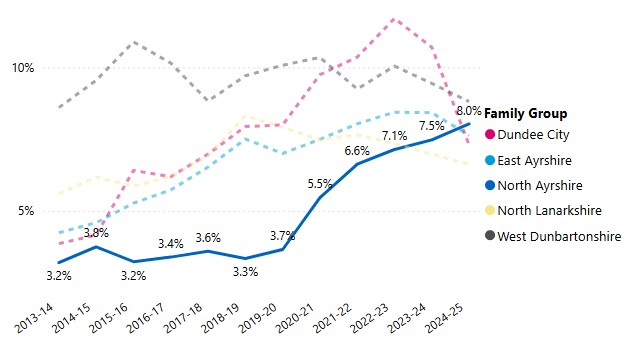
The gross rent arrears (all tenants) as a percentage of rent due for the year was 8.0% at the latest data release (September 2025). This is higher than the family group average of 7.7% but lower than the Scottish average of 8.6%. We are second lowest in our family group (of five local authorities) with only West Dunbartonshire Council performing less strongly. We have moved from 7 to 14 in rank resulting in a reduction in quartile from 1st to 2nd.
HSN3 – Proportion of council dwellings meeting Scottish Housing Quality Standards
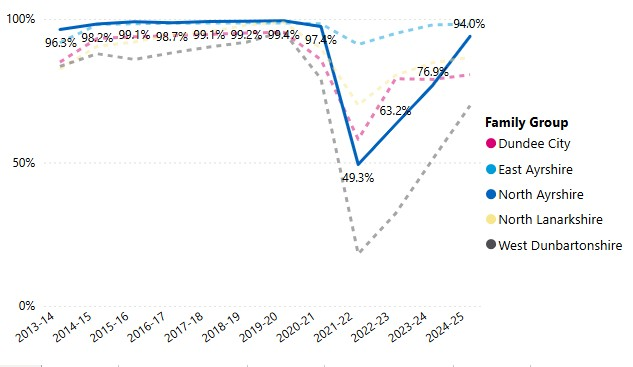
The proportion of council dwellings meeting Scottish Housing Quality Standards (SHQS) in the most recent data release (September 2025) was 94.0% - this is in comparison to the family group average of 85.9%. In our family group, only East Ayrshire Council reported a higher compliance rate of 98.2%. We currently rank 3rd of all Scottish local authorities – an improvement from 16th in the previous year and have subsequently moved from the 2nd quartile to the 1st.
CORP7 – Percentage of income due from Council Tax received by the end of the year
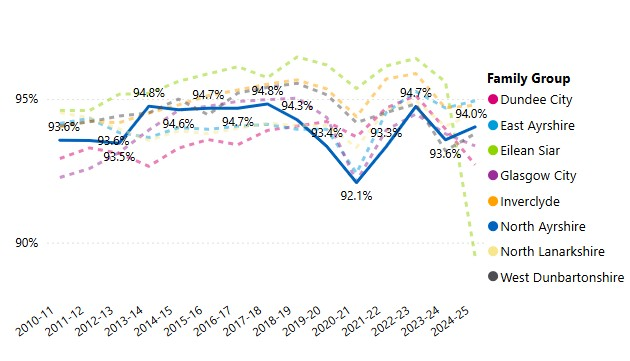
The most recent data release (September 2025) shows that 94.0% of income due from Council Tax was received by the end of the year compared to the family group average of 93.5%. We remain in the 4th quartile however our ranking has improved from 30 to 26. In terms of performance, we are fourth in our family group with East Ayrshire, Inverclyde and North Lanarkshire Councils performing more strongly. The reported performance represents an improvement from the previous year. However, underlying performance continues to remain below pre-pandemic levels. Collection activity in relation to Council Tax debt continues, with the achievement of budgeted recovery levels forecast over the medium term. As detailed in the Mid-Year 2025 to 2026 Progress Report, we continue to support residents throughout the year through repayment plans and where required through directing residents to other money advice supports available. Ongoing encouragement for residents to use the direct debit payment method should help improve collection levels in future.
Other Services
The table below displays the short term, medium term and long term comparisons against our current year for our 12 Other Services family group indicators that have been updated since our year end report. When 10 full recording periods were not available the most historical figure has been used for the long term comparison. Each indicator is linked to a chart later in the document that provides more information.
In summary, of the 12 indicators over the short, medium and long term:
- Short Term Family Group Rank – six have improved and six have declined.
- Medium Term Family Group Rank – nine have improved and three have declined.
- Long Term Family Group Rank – eight have improved, three have declined and one has stayed the same.
| Icon | Label |
|---|---|
| Improved |
| Stayed the same |
| Declined |
| Short Term, Medium Term and Long Term Comparisons for our Other Services Family Group | Current Year | Short Term Comparison | Medium Term Comparison | Long Term Comparison | |||||||
|---|---|---|---|---|---|---|---|---|---|---|---|
| LGBF Indicators Other Services | Year | Rank | Year | Rank | Rank improved/declined | Year | Rank | Rank improved/declined | Year | Rank | Rank improved/declined |
| CLIM1 – CO2 emissions area wide per capita | 2023-2024 | 15 | 2022-2023 | 20 | | 2020-2021 | 19 | | 2013-2014 | 19 | |
| CLIM2 – CO2 emissions area wide: emissions within scope of Local Authority per | 2023-2024 | 18 | 2022-2023 | 22 | | 2020-2021 | 19 | | 2013-2014 | 23 | |
| ENV4b - Percentage of A class roads considered for maintenance treatment | 2024-2025 | 13 | 2023-2024 | 21 | | 2021-2022 | 26 | | 2014-2015 | 27 | |
| ENV4c - Percentage of B class roads considered for maintenance treatment | 2024-2025 | 4 | 2023-2024 | 13 | | 2021-2022 | 17 | | 2014-2015 | 18 | |
| ENV4d - Percentage of C class roads considered for maintenance treatment | 2024-2025 | 23 | 2023-2024 | 26 | | 2021-2022 | 28 | | 2014-2015 | 30 | |
| ENV4e - Percentage of unclassified roads considered for maintenance treatment | 2024-2025 | 7 | 2023-2024 | 11 | | 2021-2022 | 15 | | 2014-2015 | 17 | |
| CORP3b – Percentage of the highest paid 5% of employees who are women | 2024-2025 | 6 | 2023-2024 | 4 | | 2021-2022 | 9 | | 2014-2015 | 6 | |
| CORP3c – Gender Pay Gap | 2024-2025 | 14 | 2023-2024 | 7 | | 2021-2022 | 8 | | 2015-2016 | 9 | |
| CORP8 – Percentage of invoices sampled that were paid within 30 days | 2024-2025 | 7 | 2023-2024 | 6 | | 2021-2022 | 4 | | 2014-2015 | 14 | |
| CORP-ASSET1 – Percentage of operational buildings that are suitable for their current use | 2024-2025 | 7 | 2023-2024 | 6 | | 2021-2022 | 11 | | 2014-2015 | 5 | |
| ENV06 – Proportion of total household waste arising that is recycled | 2024-2025 | 9 | 2023-2024 | 4 | | 2021-2022 | 2 | | 2014-2015 | 2 | |
| ECON04 – Proportion of procurement spent on local enterprises | 2024-2025 | 20 | 2023-2024 | 19 | | 2021-2022 | 24 | | 2014-2015 | 26 | |
CLIM1 – CO2 emissions area wide per capita
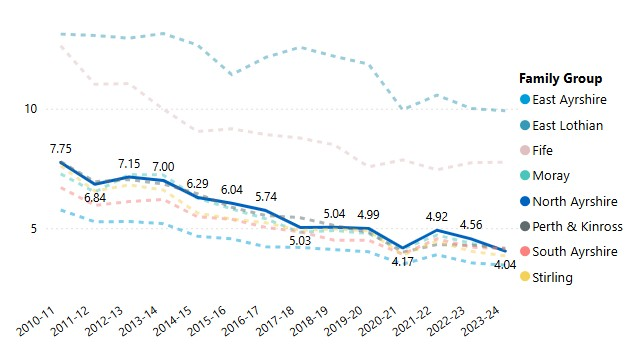
CO2 emissions area wide per capita for North Ayrshire was 4.04. This is lower than both the family group average of 5.18 and the Scotland wide average of 4.59. We are positioned third in our family group ranking, higher than Moray (4.10), South Ayrshire (4.14), Perth and Kinross (4.16), Fife (7.76) and East Lothian (9.91). Only East Ayrshire (3.46) and Stirling (3.84) were ranked higher.
CLIM2 – CO2 emissions area wide: emissions within scope of LA per capita
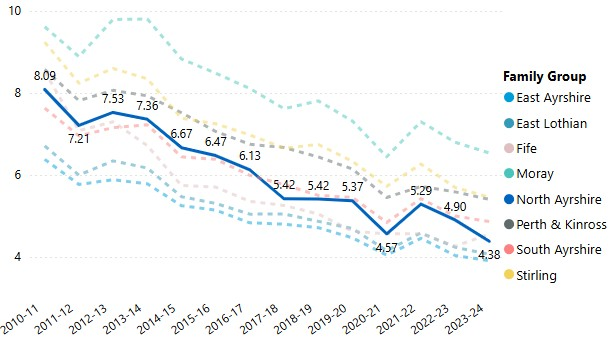
CO2 emissions area wide: emissions within scope of LA per capita was 4.38. This is lower than the family group average of 4.90, but higher than the Scotland wide average of 4.04. We are third in our family group above Fife Council (4.56), South Ayrshire Council (4.86), Perth and Kinross Council (5.40), Stirling Council (5.46) and Moray Council (6.54). Only East Ayrshire Council (3.91) and East Lothian Council (4.06) were ranked higher.
ENV4b - Percentage of A class roads considered for maintenance treatment
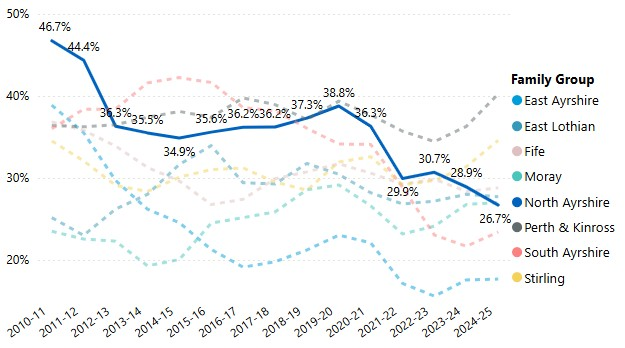
The percentage of A class roads considered for maintenance treatment for North Ayrshire Council is 27% for the 2023 to 2025 reporting period. This is lower than the family group average of 28.4% and the Scotland wide average of 31%. Within our family group rankings, we currently rank higher than East Lothian Council (28%), Fife Council (29%), Stirling Council (35%) and Perth and Kinross Council (40%). Only East Ayrshire Council (18%) and South Ayrshire Council (23%) are currently ranked higher. Moray Council also has 27% of A class roads considered for maintenance treatment.
ENV4c - Percentage of B class roads considered for maintenance treatment
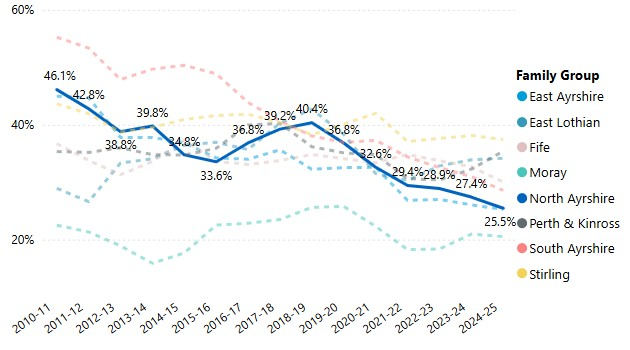
The percentage of B class roads considered for maintenance treatment for North Ayrshire Council is 25% for the 2023 to 2025 reporting period. This is lower than the family group average of 29.5% and the Scotland wide average of 35%. Within our family group rankings, we currently rank higher than South Ayrshire Council (29%), Fife Council (30%), East Lothian Council (34%), Perth and Kinross Council (35%) and Stirling Council (37%). Only Moray Council (21%) and East Ayrshire Council (25%) currently rank higher.
ENV4d – Percentage of C class roads considered for maintenance treatment
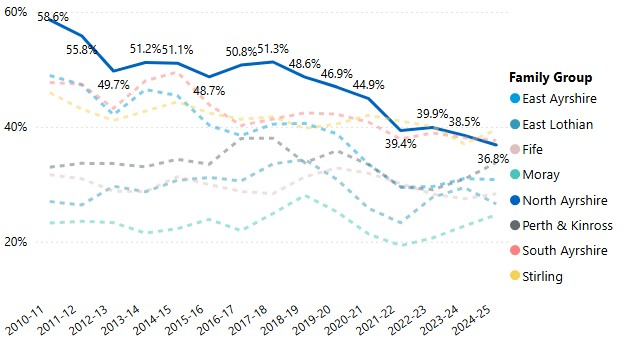
The percentage of C class roads considered for maintenance treatment for North Ayrshire Council is 37% for the 2023 to 2025 reporting period. This is higher than the family group average of 32.5% and the Scotland wide average of 34%. Within our family group rankings, we currently rank higher than South Ayrshire Council (38%) and Stirling Council (40%). However, Moray Council (25%), East Lothian Council (27%), Fife Council (28%), East Ayrshire Council (31%) and Perth and Kinross Council (34%) all rank higher than North Ayrshire Council.
ENV4e – Percentage of unclassified roads considered for maintenance treatment
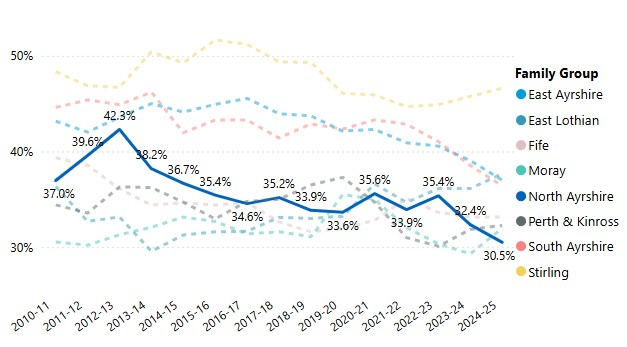
The percentage of unclassified roads considered for maintenance treatment for North Ayrshire Council is 31% for the 2021 to 2025 reporting period. This is lower than the family group average of 35.8% and the Scotland wide average of 36%. We are currently positioned highest in our family group rankings.
ENV06 – Proportion of total household waste arising that is recycled
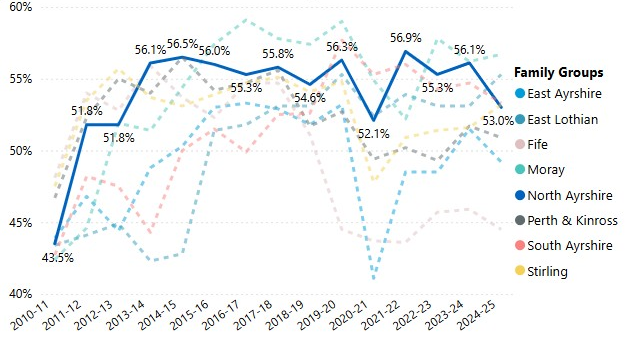
The proportion of total household waste arising that is recycled for 2024 to 2025 is 53%. This places us 5th in our family group rankings. Which means Moray (56.7%), East Lothian (55.3%), South Ayrshire (53.3%) and Stirling Councils (53.2%) are currently ranked higher than North Ayrshire Council. Perth and Kinross (50.9%), East Ayrshire (49.2%) and Fife Councils (44.5%) are ranked lower. This places North Ayrshire Council 9th in Scotland and the 2nd quartile. The council manages the largest waste tonnage out of the top nine councils, managing over 8,200 tonnes more waste per year than any of the other councils who are in the top nine. The average recycling rate in Scotland for 2024 was 44.3% and North Ayrshire Council achieved 8.7 percentage points above the national average.
CORP-ASSET1 - % of operational buildings that are suitable for their current use
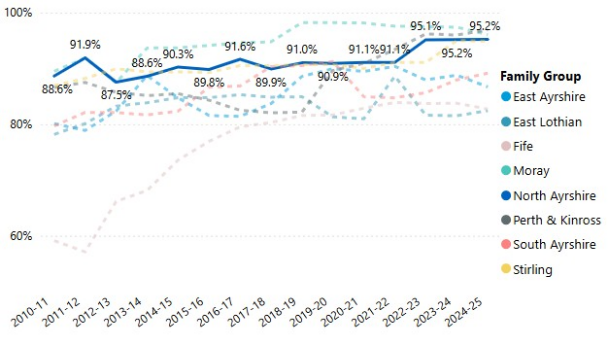
The percentage of operational buildings that are suitable for their current use is currently 95.2%. This means that we are 3rd in our family group behind both Perth and Kinross Council (96.9%) and Moray Council (96.1%). We are ranked 7th in Scotland and this places us within the 1st quartile. Condition information is gathered across the corporate estate and used to inform asset management decision in relation to property rationalisation and investment decisions. Accommodation changes are presently focused within the Irvine estate with improvements being made to Cunninghame House to enable the relocation of employees from Bridgegate House. Condition improvement works have been completed at Skelmorlie Primary and are currently progressing at Goldcraigs Depot, Hayocks Primary School and Caledonia Primary School.
CORP8 Percentage of invoices sampled that were paid within 30 days
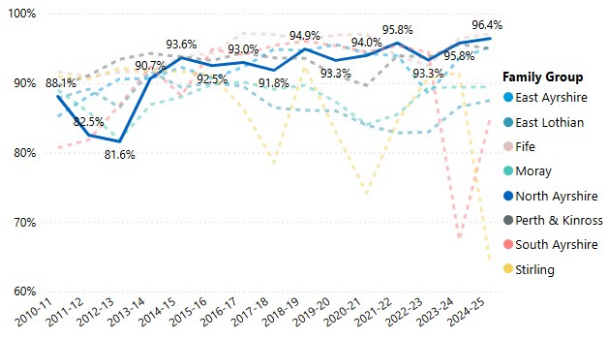
The percentage of invoices sampled that were paid within 30 days was 96.4% at the latest data release (September 2025), this is in comparison to a family group average of 88.7%. In terms of performance within our family group, we are currently second highest with only Fife Council having stronger performance (97.1%).
CORP3b - % of the highest paid 5% of employees who are women
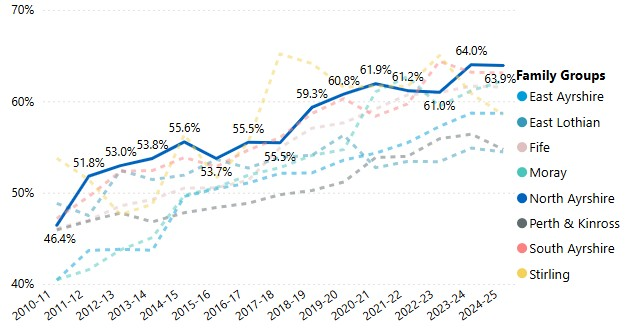
63.9% of our highest paid 5% of employees are women. This is the highest in our family group. Our relative position is currently 6th out of the 32 local authorities. As a result we are within the 1st quartile.
CORP3c - Gender Pay Gap
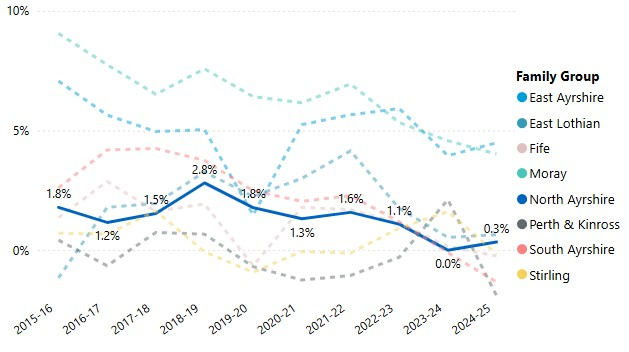
The most recent figures reported for North Ayrshire Council show that the gender pay gap is currently 0.3% (the second lowest level over the decade presented above). This means we currently sit 5th within our family group with Stirling (-0.15%), Fife (-0.25%), South Ayrshire (-1.33%) and Perth and Kinross Councils (-1.90%) ranked higher. East Lothian (0.65%), Moray (4.02%) and East Ayrshire Councils (4.49%) are ranked lower. We are 14th in Scotland and currently sit within the 2nd quartile.
ECON04 – Proportion of procurement spent on local enterprises
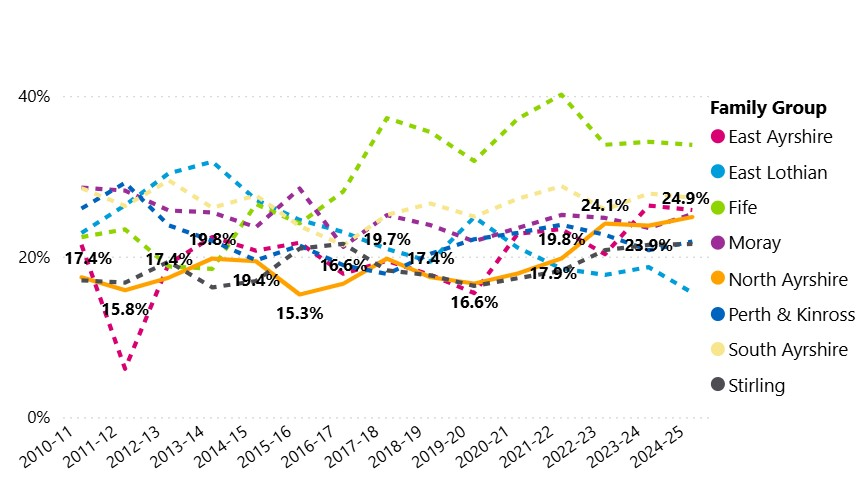
The proportion of procurement spent on local enterprises for 2024 to 2025 was 24.9% (the highest level in the period being reported on). This means that we are 5th within our family group with Fife (33.9%), South Ayrshire (27.3%), East Ayrshire (25.8%) and Moray Councils (25.3%) ranking higher. Perth and Kinross (21.9%), Stirling (21.6%) and East Lothian Councils (15.5%) all rank lower. We are currently 20th out of the 32 local authorities. This places us in the 3rd quartile. This indicator is a useful comparison for benchmarking purposes however, as it does not capture all spend due to specifically excluding any supplier spend under £1,000 or suppliers not designated as core trade organisations, it is therefore not an accurate reflection of the economic activity solely within North Ayrshire. As we have access to the source data used by the LGBF, we are able to capture all spend data and refine the calculation at a local level to better reflect our spend with local enterprises and shorten the time delay in reporting. Our most recent local figure is 26.8% for 2024 to 2025, 1.9 percentage points higher than reported within the LGBF.
Contact us
We strive to make our reporting as accessible as possible. If you have any questions or require further information on our council’s performance please contact:
The Corporate Policy and Performance Team
Telephone: 01294 310000
Email: NorthAyrshirePerforms@north-ayrshire.gov.uk
Reports can be viewed on our council performance webpage.