Translate
1. Introduction
North Ayrshire Council has a statutory obligation, under Section 34 of the Roads (Scotland) Act 1984, to take such steps as it considers reasonable to prevent snow and ice endangering the safe passage of pedestrians and vehicles over public roads which includes carriageways, footways, footpaths, pedestrian precincts.
In its statutory role as the local Roads Authority, the aim of North Ayrshire Council in respect of its winter service and weather emergencies is to:
- provide a standard of service on public roads which will permit safe movement of vehicular and pedestrian traffic appropriate to the prevailing weather conditions.
- establish a pattern of working which will keep delays, diversions, or road closures to a minimum during adverse weather conditions.
- conduct operations having regard to the requirements of the Health & Safety at Work Act 1974 and any other relevant enactments.
This Plan only relates to the Council’s duties as Roads Authority and does not cover the wider response of the Council during winter and other weather emergencies.
North Ayrshire Council has no responsibility for the treatment of trunk roads. From 1 April 2001, the contract for management and maintenance of the trunk roads in Scotland has been awarded by the Scottish Government to the private sector. The successful contractor for the South West of Scotland is Amey and the roads involved in North Ayrshire are as follows:
- A78 full length from Meadowhead roundabout, Dundonald to Inverclyde boundary at Skelmorlie.
- A737 Dalry Road, Kilwinning to Renfrewshire boundary.
- A738 Pennyburn roundabout to A737 Dalry Road, Kilwinning
All winter gritting and snow clearing operations on these roads will be the responsibility of Amey. North Ayrshire Council’s Neighbourhood Services (Roads) and Amey liaise on a regular basis during periods of adverse weather to provide the best possible service to the travelling public.
North Ayrshire Council is also responsible for the management and operation of the coastal flood protection controls at Largs and Saltcoats. The Council will close the flood gates on the promenade and erect the flood barriers at Largs Pier in advance of predicted severe weather with minimum disruption to promenade users and the Largs to Cumbrae ferry. Coastal flooding can occur at any time and, accordingly, the Council will provide this service throughout the year.
In the event of extreme weather similar to that which was experienced on Arran late March 2013, where major disruption affected large parts of the community, a coordinated response is adopted by the Council to ensure public safety. In dealing with such emergencies, Police Scotland initially lead the emergency or response stage of the emergency. Thereafter, the Council leads the recovery stage. Generally, there are 3 levels of Civil Contingencies response. There is a strategic group at National or Strathclyde wide level, a tactical group at North Ayrshire level and an operational group at local level.
The Ayrshire Civil Contingencies Team (ACCT) act as lead for the Council and implement the Civil Contingencies Plan liaising with all relevant Stakeholders identified within the Plan.
2. Priorities for winter treatment
North Ayrshire Council has defined the priorities for carriageway and footway/footpath treatment as follows:
2.1.1 Carriageway Priorities
Where slush is formed, this shall be removed as soon as practicable to avoid the risk of rutting should there be a further significant fall in road temperatures which might result in freezing conditions.
2.1.2 Carriageway Routes for Proactive Treatment
Priority 1 – Strategic, Main Distributor and Distributor routes, bus routes and certain pre-determined Secondary Distributor routes identified from the Local Transport Strategy (LTS) will be treated when it is forecast that snow or ice is likely to be present on road surfaces.
Due to the various climatic domains within North Ayrshire the Priority 1 routes may be adjusted to cover either the four pre-determined Inland Routes or two pre-determined High Routes which all currently form part of our existing Priority Network. Priority 1 gritting routes are available on our Winter gritting page.
2.1.3 Carriageway Routes for Reactive Treatment
Priority 2 – Remaining Secondary Distributor, local access, and residential distributor roads.
Given the presence of ice and snow, Priority 2 routes may be treated during normal working hours as resources permit, when sub-zero temperatures are forecast to continue beyond midday following completion of Priority 1 routes.
Priority 3 – The remaining road network including minor rural unclassified routes and remaining residential areas not already covered.
Priority 3 routes will be treated as resources permit when sub-zero conditions are forecast to continue over an extended period only after all Priority 1 and Priority 2 routes are clear unless it is identified as an emergency.
2.1.4 Carriageway Routes for Snow Clearance
On receipt of a weather warning predicting medium (25 - 100 millimetres deep) or heavy (over 100 millimetres deep) snowfalls, the Network and Operations Manager where appropriate, will recall to depots such vehicles capable of being equipped with snow ploughs.
While snow is still falling the Strategic and Main Distributor Network will be prioritised for ploughing and treatment in order to target resources and to keep these routes open for traffic.
After snow has stopped falling but is lying, the remaining Priority 1 precautionary routes will be ploughed and treated before commencing ploughing and treatment on Priority 2 and Priority 3 routes as resources and conditions permit.
2.1.5 Cumbrae
There are no Roads Operatives based on the Isle of Cumbrae, however contract arrangements have been made to carry out gritting operations and assist with weather emergencies on the Island.
2.2 Footway/Footpath Priorities
With limited resources available footways and footpaths will only be treated when considered necessary (heavy snowfall or extensive icing). They will normally only be treated during normal working hours (commencing from 8am), but arrangements are in place to undertake emergency work out of normal working hours, weekends, and public holidays in extreme circumstances.
Generally, treatment of footways and footpaths will be reactionary and not pre-programmed, and where possible work will be undertaken during normal working hours.
When treatment is instructed the following priorities will apply:
Priority 1 Routes will be considered for treatment if it is forecast that ice or snow is likely to be present or where surfaces are wet with temperatures forecast to remain below zero until 10am the next working day.
Priority 1 Routes - Urban shopping areas and precincts, footway access to schools, emergency facilities including fire and rescue, police and ambulance services, hospitals, sheltered housing, doctors surgeries and health centres.
Priority 2 routes will be treated if it is forecast that ice or snow is likely to be present with temperatures forecast to remain below zero for a prolonged period only after priority 1 routes are clear.
Priority 2 Routes - Steep hills on main distributor and residential distributor routes, routes to bus stops, only after all Priority 1 have been cleared:
Priority 3 routes will be treated if it is forecast that ice or snow is likely to be present with temperatures forecast to remain below zero for a prolonged period only after priority 1 and 2 routes are clear.
Priority 3 Routes - Other areas of high pedestrian concentration.
Streetscene staff will assist with the treatment of footways.
To maximise coverage on footways, generally only one side of a road will be initially treated.
It is not possible for the Council to treat all footways and footpaths within North Ayrshire. As such the Council encourages the community to participate in self-help, through the use of grit bins which can be requested through the grit bin application process. Grit bins will only be allocated where it has been assessed and deemed as an appropriate location by the Council.
2.3 Cycle Routes
With limited manpower resources no treatment will be carried out on off road cycle routes.
2.4 Response and Treatment Times
Routine precautionary salting of priority 1 carriageway routes should be completed within 3 hours of the planned start time. For emergency or unplanned salting, the start time from leaving the depot shall be no more than 1 hour.
3. Organisation
The Head of Neighbourhood Services is responsible for specifying the level of winter service required based on approval from the Council. The Network and Operations Manager is responsible for implementing this service.
A duty Winter Controller and Winter Supervisor will be appointed by the Network and Operations Manager for the whole of the winter period covered by these procedures (mid-October to early April).
4. North Ayrshire Council resources (Roads)
4.1 General
Following approval from the Council, it is the responsibility of the Head of Neighbourhood Services to define the level of service to be provided within their sphere of operations and to issue appropriate instructions to the Network and Operations Manager to provide the necessary labour and plant for winter operations. This level of service will be based on the national Code of Practice for Well Managed Highway Infrastructure (see Appendix A).
The level of winter treatment is established utilising the weather forecasts provided by MetDesk Limited in accordance with the winter treatment matrix (Appendix B).
The Network and Operations Manager shall thereafter be responsible for advising the Head of Service of any matters which may affect his ability to deal with adverse weather conditions such as. labour disputes, extensive plant breakdowns.
Labour resources from Neighbourhood Services (Roads) will be provided for the Winter and Weather Emergencies Service. The stand-by period will be 23 October 2025 until 9 April 2026. This period may be extended beyond the given dates if conditions warrant such action. These arrangements include home stand-by which is activated by the designated Winter Supervisor when instructed by the Winter Controller or as the result of hazardous road conditions being reported.
4.2 Labour
A proportion of the roads labour force will be on stand-by for winter service operations out of normal working hours, with the remainder on call out as necessary. This allows evening and early morning precautionary salting to be carried out on our priority carriageway network to undertake treatment before the morning rush hour.
In determining the labour resources required for the winter service, cognisance is taken of the key objective to treat all priority routes before the commencement of the morning peak period.
4.3 Vehicle Plant and Equipment
Prior to commencement of winter service operations, the Senior Manager (Network) will ensure that all equipment for salting roads and snow clearing is in working order and, where appropriate, that ancillary items can be fitted to vehicles without difficulty, such as ploughs set up on blocks to facilitate assembly. The above procedure should also be applied to vehicles and plant available under contract for the winter service.
The Senior Manager (Network) will ensure that all vehicles engaged in the winter service are equipped with radios or other appropriate communication devices to allow contact to be maintained between the depot and operators. Superintendents have mobile telephones. There is also vehicle tracking system fitted and operational in all vehicles to reduce the risk associated with gritting operations.
A summary of labour, vehicles, plant, and equipment available for the winter service work is detailed in Appendix C.
Once per year the Senior Manager (Network), will organise a trial closure of the flood gates and erection of the de-mountable barriers at the Largs and Saltcoats flood protection controls. This is to ensure that the gates and barriers remain in full working order and that all staff are familiar with the process.
4.4 Salt
Salt is purchased through a Scotland Excel annual purchase contract. Mainland salt deliveries are stored in the salt barn within the Goldcraigs Depot. Salt on Arran is stored in the open at the Roads Depot in Market Road, Brodick.
During the season, the Senior Manager (Network) will arrange for a weekly check to be made on the amount of salt used and for stocks to be augmented as necessary. There is a procedure in place at the depot to strictly control salt distribution. All vehicles are tagged and must cross the weighbridge to accurately record salt usage. This includes salt distributed to Streetscene and contractors assisting with winter service delivery.
Small quantities of salt are available for issue free of charge to the public, subject to residents supplying a suitable container. Details of locations of community grit bins where small quantities of salt are available are given in Appendix D
The planned salt stock level at commencement of winter is given in Appendix E.
In the event of prolonged severe weather, the Council has a salt resilience plan (Appendix F), which will be implemented if conditions require.
5. Other resources
During adverse weather conditions, the Network and Operations Manager, (after consultation with the Head of Neighbourhood Services), shall, if necessary, augment his resources by the use of personnel from Streetscene and external contractors at rates agreed prior to engagement through a framework contract. The Head of Neighbourhood Services should be advised, as soon as practicable, of external resources engaged as a result of decisions made out with normal working hours.
The Network and Operations Manager will provide a supply of salt to Streetscene and external contractors where appropriate to permit the treatment of agreed footways/footpaths. This will be managed through a salt management system based at Goldcraigs Roads Depot.
6. Weather forecasting
North Ayrshire Council, through a collaborative contract led by South Lanarkshire Council, has appointed MetDesk Limited, as their weather forecast provider. During the winter service period MetDesk Limited will provide a weather forecasting service and monitor road and weather conditions.
The forecasters receive, monitor, and interpret, climatic, ice prediction and weather radar information on a continuous basis and provide detailed weather forecasts on a daily basis during the whole winter period.
SEPA operate a coastal flood warning system for the Firth of Clyde. If storm surges and coastal flooding are predicted, SEPA provide advance warning to the Council by e-mail and also through their Floodline service which is available on their website or by phone. This service is available all year round.
7. Decision making
The Network and Operations Manager will appoint suitably trained and experienced personnel as Winter Controllers.
During the winter season the Winter Controller will receive the weather forecast around 12.00 hours and decide on the treatment to be carried out. The Winter Controller will check the treatment decision of neighbouring authorities for consistency and reconsider if necessary. The weather forecast provider will provide an evening forecast around 18.00 hours and if this update indicates any change in the forecast the Winter Controller will amend the decision accordingly and advise the Winter Supervisor.
For out of office hours, Saturdays, Sundays and public holidays the Network and Operations Manager shall provide the weather forecast provider with contact telephone numbers of the on-duty Winter Controller. If the forecast conditions change from good to adverse at any time, then the weather forecast provider will phone the Winter Controller either at work or at home as appropriate. Thereafter, it is the responsibility of the Winter Controller to take action including the calling out of stand-by squads to undertake salting/snow clearing.
Winter Controllers have the facility at any time to contact the weather forecast provider for advice or clarification of forecasts. These arrangements will be in place from 6 October 2025 until 23 April 2026 and these dates can be extended if required.
The decision-making process is illustrated in Appendices A and B.
The Head of Neighbourhood Services will appoint suitably trained staff and experienced personnel to manage the coastal flood prevention schemes at Largs and Saltcoats. During the winter season, this will be the Winter Controller.
8. Ice prediction
In addition to the weather forecast information, the Council has available further information from sensors which have been installed at the locations listed below:
- A78 Ardrossan
- A78 Sharphill
- A737 Highfield
- A760 Catburn
- A735 Near Dunlop
- B880 Arran, summit of The String
The sensors provide current details of road and air temperatures and indicate the presence of moisture, thereby identifying locations that icing has occurred or where there is a risk that icing will occur.
By utilising the data from these sensors, the weather forecast provider is able to supplement their forecast by producing site specific forecasts. The above information is available to the Winter Controller via computer link 24 hours a day throughout the winter period.
9. Road condition reports
During periods of adverse weather, the Network and Operations Manager shall receive reports on road conditions from the Winter Supervisor by 9.45am. These reports should be updated as necessary depending on changing circumstances.
10. Communications
The Head of Neighbourhood Services or nominated senior manager will deal with statements to the Press, Radio, and Television regarding road conditions throughout the area. The Council’s Communication team will assist and may take the lead role depending on the nature of any significant event.
General advice and information, along with timeous service updates, will be placed on the Council’s website.
The Head of Neighbourhood Services (or nominated senior officer) will ensure that all staff involved in communication with members of the public are fully briefed with consistent and accurate information.
A protocol has been agreed by the West of Scotland Regional Resilience Partnership (WoS RRP) and Ayrshire Civil Contingencies Team (ACCT) for the transfer of information in relation to Winter and Weather Emergencies.
The Council’s daily winter decisions are available for the public and can be accessed via the Council’s website. Any winter and weather emergencies can be reported to North Ayrshire Council and the Trunk Road Operators using the contact information contained within Appendix G.
The distribution list for winter weather emergencies can be found under Appendix H.
11. Road closures
Where it is considered that a road is rendered unsafe due to adverse winter conditions then Police Scotland or persons acting on behalf of the Chief Constable will arrange to have the road closed and advise the on-duty Winter Supervisor as soon as possible of their actions. The Winter Supervisor will advise the Winter Controller/Network and Operations Manager of any road closures. Appropriate measures will also be taken to re-direct traffic and to ensure that the necessary signs are put in place. When the road affected is a through route the adjoining Councils will be kept informed. Police Scotland will advise the other emergency services (Ambulance and Fire) of the closures.
Prior to signing diversionary routes, the capacity of the roads and the headroom and weight restrictions of structures should be checked with the Winter Controller to ensure that they are adequate (see Appendix I).
12. Liaison with Police Scotland
Neighbourhood Services (Roads) will ensure close liaison with Police Scotland, particularly during periods of severe weather.
Where practicable, Police Scotland will be informed in advance of North Ayrshire Council’s proposed operations. Similarly, arrangements have been made for exchanging information on proposed actions with neighbouring authorities and the trunk road operating company.
Where necessary the service will request appropriate assistance from Police Scotland when moving equipment, arranging road closures, and dealing with abandoned vehicles.
Reports from Police Scotland regarding dangerous road conditions should be acted upon by the Winter Supervisor as soon as practicable, having regard to priorities in this document and the conditions pertaining throughout the area.
13. Ayrshire Local Resilience Partnership (ALRP) Disruptive Weather Response Arrangements
There have been several occasions when severe weather including high winds, heavy rain and snow has caused disruption to communities and services in Ayrshire. Arrangements are in place where partner organisations can trigger the ALRP Disruptive Weather Response Arrangements. The purpose of these arrangements are:
- To protect human life, property, and the environment
- To implement a professional and coordinated multi-agency response to the incident in conjunction with our communities.
- To maintain wider public confidence in the multi-agency response and minimise general community and infrastructure impact.
- To ensuring that all possible measures are in place to protect vulnerable or displaced members of the community.
- To support effective public communication regarding the incident along the principles of warning and informing.
- To ensure awareness of the potential impact of events out with Ayrshire on the local multi-agency response.
- To ensure that organisational and partnership learning points are captured to ensure a continuing focus on safeguarding the public.
14. Cross boundary arrangements
Because the Council boundaries do not always coincide with convenient turning points at the end of gritting routes, arrangements have been drawn up with all adjacent authorities for the gritting routes to be continued short distances to appropriate turning points. See (Appendix J).
15. Vehicle routes
A thermal mapping exercise was undertaken on North Ayrshire’s road network over winter season 2018 to 2019 and routes have been developed by the Roads Service on the basis of the priorities listed in Section 2. However, in order to minimise unproductive mileage, some roads in a lower category may be treated out of sequence. This may also occur when conditions vary throughout the area.
A complete set of route cards will be kept in the Neighbourhood Services (Roads) offices, with a duplicate set being held in Goldcraigs Depot.
Treatment of precautionary carriageway salting routes should be completed within three hours of planned start time under routine conditions. When the Winter Controller instructs immediate winter service operations, the response time to start treatment should be within one hour.
It should be noted that gritting routes are either at or close to capacity and it is unlikely that any additions to routes could be considered without additional finance and human resources.
16. Precautionary salting
On receipt, within normal working hours, of a forecast from the weather forecast provider warning of frost, freezing or snow conditions, the Winter Controller in consultation with the Network and Operations Manager, shall consider precautionary salting of main roads.
Where such a warning is received out with normal working hours, the Winter Controller has delegated authority to activate call-out procedures as indicated in Section 7.
Extensive and accurate records of weather forecasts, winter treatment decisions and actions taken will be kept to demonstrate our compliance to our Winter and Weather Emergencies Plan.
17. Grit bins
There are approximately 560 grit bins distributed across North Ayrshire. These are located at areas of particular difficulty such as dangerous bends, steep gradients. The policy and procedures for siting of grit bins, and requests for additional bins is shown in Appendix K.
Grit bins will be refilled prior to the start of winter and as considered necessary during the winter season and following periods of severe weather when resources are available.
The locations of Community Grit Bins are listed in Appendix D and are also show on our Winter gritting page.
18. Largs And Saltcoats Flood Protection Schemes
On receipt of a severe weather warning predicting a combination of strong winds, high tides, or tidal surges the Winter Controller will, when necessary, instruct the closure of the flood gates on the promenade at Largs and/or the erection of the flood barriers at the Largs Pier and/or Saltcoats promenade.
19. Sandbag procedures
The deployment of sandbags to prevent or contain floodwaters can be an effective way of mitigating the effect of a flood, however the lead time for filling and deployment can be lengthy, as a large number of bags cannot be filled in advance due to storage problems. Therefore, an early decision must be taken to sandbag, to avoid a subsequent waste of time and effort. The deployment of sandbags will be decided with regard to the following priorities:
- To prevent loss of life or serious injury
- Maintenance of access for the emergency services
- Protection of vital facilities within the community
- Protection of transportation routes
- Protection of NAC property
- Protection of private dwelling houses
The decision to deploy sandbags will be made by the Winter Controller / Supervisor or appropriate officers in Building Services, Cleansing or the Island Officer on Arran in accordance with the Services' callout/emergency procedures.
Notes:
- Sandbags will not normally be deployed to protect commercial property;
- Appropriate stocks of empty and filled sandbags will be held by the Services mentioned above, based on previous usage and experience.
The above procedure mainly relates to tidal, fluvial and watercourse flooding. Where flooding occurs as a result of a blocked, damaged, or ineffective Council owned drainage systems, sandbags will be deployed as required to mitigate the effects of flooding (and reduce the likelihood of claims against the Council) including the protection of commercial property.
Sandbags are not readily available for collection by either residents nor commercial property owners in the event of heavy rain being forecast, they should make their own arrangements to ensure that their properties are protected from potential flooding.
During an emergency situation, the Council will deploy sandbags to protect transportation routes and properties as far as is possible where flooding occurs in line with priorities outlined above.
20. Resilience arrangements
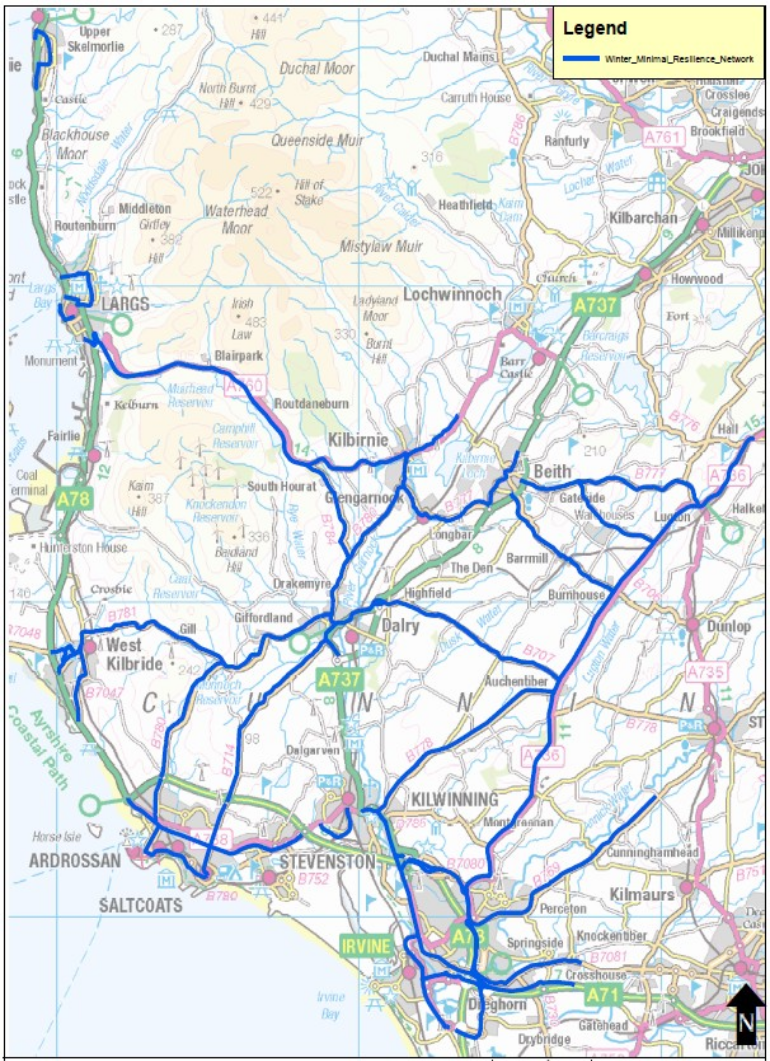
In critical situations should our operational resources be reduced, a minimum resilience network for winter gritting has been prepared. Should we have to reduce our level of service due to an extreme situation our priority gritting routes will reduce from six to three. On Arran we may require reducing from two to one gritting vehicle covering the island routes and the treatment time for gritting operations will increase accordingly.
The Head of Service will decide if the level of service has to be reduced due to extreme situations.
Details of our resilience network are attached as Appendix L.
Appendix A - Level of service
| Road Surface Temperature | Precipitation | Predicted Road Conditions Wet/Wet Patches | Predicted Road Conditions Dry |
|---|---|---|---|
| Temperature Forecast between +1.5C and +0.5C | No rain, hoar front or fog | High route patrols | No action likely |
| Temperature Forecast below +0.5C | No rain, no hoar frost and no fog | Priority 1 routes, salt before frost | No action likely |
| Temperature Forecast below +0.5C | Expected hoar frost and expected fog | Priority 1 routes, salt before frost | Priority 1 routes, salt before frost |
| Temperature Forecast below +0.5C | Expected rain before freezing | Priority 1 routes, salt after rain stops | Priority 1 routes, salt before rain stops |
| Temperature Forecast below +0.5C | Expected rain during freezing | Priority 1 routes, salt before frost as required during rain and after rain stops | Priority 1 routes, salt before frost as required during rain and after rain stops |
| Temperature Forecast below +0.5C | Possible rain, hoar frost or fog | Priority 1 routes, salt before frost | Monitor weather conditions |
| Temperature Forecast below +0.5C | Expected snow fall | Priority 1 routes and footways, salt before snow fall | Priority 1 routes and footways, salt before snow fall |
The decision to undertake precautionary treatments should be adjusted, where appropriate, to take account of residual salt.
All decisions should be evidence based, recorded, and continuously monitored and reviewed.
Appendix B - Decision making
- Rate of spread for precautionary treatments may be adjusted to take account of local variations along the routes such as residual salt, temperature variations, surface moisture (air or road surface) road alignment and traffic density.
- All decisions should be evidence based, recorded and require continuous monitoring and review.
- Ice refers to all ice on the road surface, including black ice.
- The level of service generally complies with the recommendations laid down in “NWSRG best practice guide for Winter Salt” as recommended in the Well Managed Highway Infrastructure Code of Practice and takes account of recommendations by the SCOTS Winter Group following a review of the Code of Practice and consultation with the National Winter Service Research Group (NWSRG).
Winter Treatment Spread Rate Matrix
Recommended spread rates - dry salting (g/m²)
| Road Surface Temperature (RST) when frost/ice is predicted and road wetness | Poor cover (salt stored uncovered) Medium Traffic Normal Loss | Good cover (salt stored under cover) Medium Traffic Normal Loss | Comments |
|---|---|---|---|
| RST at or above -2 deg and dry or damp road conditions | 10 | 10 | None |
| RST at or above -2 deg and wet road conditions | 15 | 10 | None |
| RST below -2 deg and above - 5 deg and dry or damp road conditions | 15 or 20 | 10 or 15 | Spread rate dependent on residual salt on road surface |
| RST below -2 deg and above - 5 deg and wet road conditions | 1 x 20 and monitor and treat as required | 20 | None |
| RST at or below -5 deg and above -10 deg and dry or damp road conditions | 1 x 20 and monitor and treat as required | 20 | Spread rate dependent on residual salt on road surface |
| RST at or below -5 deg and above -10 deg and wet road conditions | 1 x 20 and monitor and treat as required | 1 x 20 and monitor and treat as required | None |
| Salt type | Precautionary treatments before snow or freezing rain | Light or Medium Traffic | Heavy Traffic |
|---|---|---|---|
| Dry salt | Light snow forecast | 20g/m² | 20g/m² |
| Pre-wet salt | Light snow forecast | 20g/m² | 20g/m² |
| Treated salt | Light snow forecast | 15g/m² | 15g/m² |
| Dry salt | Moderate/heavy snow forecast | 20g/m² | 40g/m² |
| Pre-wet salt | Moderate/heavy snow forecast | 20g/m² | 40g/m² |
| Treated salt | Moderate/heavy snow forecast | 15g/m² | 30g/m² |
| Dry salt | Freezing rain forecast | 1 x 20g/m² then monitor | 1 x 20g/m² then monitor |
| Pre-wet salt | Freezing rain forecast | 1 x 20g/m² then monitor | 1 x 20g/m² then monitor |
| Treated salt | Freezing rain forecast | 1 x 15g/m² then monitor | 1 x 15g/m² then monitor |
Appendix C - Summary of available labour and plant
| Type of plant/labour | Goldcraigs | Arran | Other NAC | Total |
|---|---|---|---|---|
| 18 tonne uni-body gritter | 10 | 3 | 0 | 13 |
| 7.5 tonne uni-body gritter | 1 | 0 | 0 | 1 |
| Trailer gritter | 0 | 1 | 0 | 1 |
| Footway gritter | 1 | 0 | 7 | 8 |
| 18 tonne uni-body lorry | 10 | 3 | 0 | 13 |
| 26 tonne multi-lift lorry | 1 | 0 | 0 | 1 |
| 7.5 tonne uni-body lorry | 1 | 0 | 0 | 1 |
| Tractor | 0 | 0 | 9 | 9 |
| JCB 3CX | 0 | 1 | 0 | 1 |
| Telehandler | 1 | 1 | 0 | 2 |
| Fixed V plough | 3 | 2 | 0 | 5 |
| Small blade plough | 1 | 1 | 0 | 2 |
| Large blade plough | 12 | 3 | 0 | 15 |
| Drivers | 27 | 13 | 0 | 40 |
| Pickup drivers | 4 | 4 | 22 | 30 |
| Operatives | 5 | 1 | 29 | 35 |
When necessary, labour, vehicles, plant and equipment from other Council Departments, plant hirers and contractors will be used to supplement above resources.
This also applies for non-winter related emergency responses.
Appendix D - Community Grit Bins
Small quantities of salt are available for issue free of charge to members of the public, subject to their supplying a suitable container from the Community Grit Bins sited at the following locations.
- Ardrossan – Car park, North Crescent Road
- Beith – Community centre, Kings Road
- Brodick – Household waste recycling centre
- Dalry – Car park, Kirk Close
- Fairlie – Car park, Pier Road
- Irvine – Bartonholm civic amenity site
- Kilbirnie – Cleansing depot, Paddockholm Road
- Kilwinning – Byrehill Place (off Pennyburn Road)
- Lamlash – Council office
- Largs – Cleansing depot, Alexander Avenue
- Millport – Kepple Pier
- Saltcoats – Cleansing depot, Mid Dykes Road
- Skelmorlie – Toward View (opposite fire station)
- Stevenston – Car park, Garnock Road
- West Kilbride – Community Centre, Corse Street
Appendix E - Summary of available materials
The following salt, grit and sand stocks will be in place at commencement of winter:
Goldcraigs (salt barn)
- 6000 tons of salt
- 100 tons of sand for sandbags
Arran
- 2400 tons of salt
- 300 tons of sand for sandbags
Cumbrae
- 20 tons of salt
- 500 filled sandbags
Appendix F - Salt Resilience Plan
Level 1 (Green) Service
Stock Levels: 2500 Tonnes and above
- Service levels as detailed in NAC Winter and Weather Emergencies Plan
- Typical daily salt usage (snow conditions) 470T – resilience 8 days, or
- Typical daily salt usage (frost and ice only) 235T – resilience 16 days
Level 2 (Amber 1) Service
Stock Levels: 1800 to 2500 Tonnes
- Only Priority 1 carriageway routes treated with pure salt, remaining priority carriageway routes reduced to half the normal spread rate or salt/grit mix at 50/50
- All footway routes reduced to salt/sand mix at 50/50
- Grit bins replenished with salt/sand mix at 50/50
- Typical daily salt usage (snow conditions) 330T – resilience 2 days, or
- Typical daily salt usage (frost and ice only) 165T – resilience 4 days
Level 3 (Amber 2) Service
Stock Levels: 1000 to 1800 Tonnes
- All carriageway routes reduced to half the normal spread rate or salt/grit mix at 50/50
- Priority 1 footway routes treated with salt/sand mix at 50/50
- Remaining footway routes treated with sand/grit mix at 50/50
- Grit bins replenished with sand/grit mix at 50/50
- Typical daily salt usage (snow conditions) 150T – resilience 5 days, or
- Typical daily salt usage (frost and ice only) 75T – resilience 10 days
Level 4 (Red) Service
Stock Levels: less than 1000 Tonnes
- Priority 1 carriageways reduced to half the normal spread rate or salt/grit mix at 50/50
- Treat remaining carriageway routes with sand/grit mix at 50/50
- All footway routes treated with sand/grit mix at 50/50
- Grit bins replenished with sand/grit mix
- Typical daily salt usage (snow conditions) 100T – resilience 10 days, or
- Typical daily salt usage (frost and ice only) 50T – resilience 20 days
Assuming 7000 tonnes in stock at start of winter our total resilience would be either:
- Total Resilience during periods of heavy snow - 27 days, or
- Total Resilience during periods of frost and ice conditions - 54 days
Level 1 (Green) Service
Stock Levels: 1000 Tonnes and above
- Service levels as detailed in NAC Winter and Weather Emergencies Plan
- Typical daily salt usage (snow conditions) 52T – resilience 28 days, or
- Typical daily salt usage (frost & ice only) 26T – resilience 56 days
Level 2 (Amber 1) Service
Stock Levels: 550 to 1000Tonnes
- Only Priority 1 carriageway routes treated with pure salt, remaining priority carriageway routes reduced to half the normal spread rate or salt/grit mix at 50/50
- All footway routes reduced to salt/sand mix at 50/50
- Grit bins replenished with salt/sand mix at 50/50
- Typical daily salt usage (snow conditions) 44T – resilience 10 days, or
- Typical daily salt usage (frost & ice only) 22T – resilience 20 days
Level 3 (Amber 2) Service
Stock Levels: 250 to 550 Tonnes
- All carriageway routes reduced to half the normal spread rate or salt/grit mix at 50/50
- Priority 1 footway routes treated with salt/sand mix at 50/50
- Remaining footway routes treated with sand/grit mix at 50/50
- Grit bins replenished with salt/sand mix at 50/50
- Typical daily salt usage (snow conditions) 30T – resilience 10 days, or
- Typical daily salt usage (frost & ice only) 15T – resilience 20 days
Level 4 (Red) Service
Stock Levels: less than 250 Tonnes
- Priority 1 carriageways reduced to half the normal spread rate or salt/grit mix at 50/50
- Treat remaining carriageway routes with sand/grit mix at 50/50
- All footway routes treated with sand/grit mix at 50/50
- Grit bins replenished with sand/grit mix
- Typical daily salt usage (snow conditions) 20T – resilience 12 days, or
- Typical daily salt usage (frost & ice only) 10T – resilience 24 days
Assuming 2,400 tonnes in stock at start of winter our total resilience would be either
- Total Resilience during periods of heavy snow - 60 days, or
- Total Resilience during periods of frost & ice conditions - 120 days
Appendix G - Contact address and telephone numbers
During working hours
North Ayrshire Council, Neighbourhood Services (Roads), Cunninghame House, Irvine, KA12 8EE
Telephone: 01294 310000
Arran Local Office, Lamlash, Isle of Arran, KA27 8JY
Telephone: 01770 600338
Trunk Roads, A78, A737 and A738, Amey, Network Control Centre, 150 Polmadie Road, Glasgow, G5 0HD
Control Room telephone: 0800 042 0188
Email: OCCR-southwest@amey.co.uk
Outside of working hours
North Ayrshire Council, Call centre – road and lighting faults, 24 hours, seven days a week
Telephone: 01294 310000
Appendix H - Distribution list
North Ayrshire Council
| Holder | Number of copies |
|---|---|
| Chief Executive | 1 |
| Executive Director: Place | 1 |
| Executive Director: Communities & Education | 1 |
| Head of Neighbourhood Services | 1 |
| Head of Housing and Public Protection | 1 |
| Head of Democratic Services | 1 |
| ACCT | 1 |
| All Elected Members of North Ayrshire Council | 33 |
Police Scotland
| Holder | Number of copies |
|---|---|
| Divisional Commander, Kilmarnock | 1 |
| Traffic Management, Ayr | 1 |
Other organisations
| Holder | Number of copies |
|---|---|
| Strathclyde Partnership for Transport | 1 |
| Scottish Fire & Rescue Service – Divisional Commander | 1 |
| Scottish Ambulance Service | 1 |
| MetDesk Limited | 1 |
| Amey | 1 |
| Ayrshire Roads Alliance | 1 |
| Renfrewshire Council - Head of Roads | 1 |
| East Renfrewshire Council – Head of Roads & Planning | 1 |
| Inverclyde Council – Head of Transportation & Roads Service | 1 |
| Contact Centre, Building Services, Stevenston | 1 |
| Contact Centre, Bridgegate House, Irvine | 1 |
Appendix I - Bridges with weight or height restrictions
Height restrictions
| Bridge location | Grid reference | Signed height metric | Signed height imperial |
|---|---|---|---|
| B714/50: Dalry, Railway Bridge | 229960 649702 | 3.8 | 12’ – 6” |
| B706/40: Barrmill | 236834 651392 | 4.0 | 13’ – 0” |
| B7047/10: Meadowfoot Road, West Kilbride | 220791 647032 | 4.6 | 15’ – 0” |
| C6/10: West Balgray | 235333 642491 | 3.9 | 12’ – 9” |
| C26/10: South Kilruskin | 220541 650473 | 4.4 | 14’ – 6” |
| C26/20: North Kilruskin | 220423 650868 | 5.0 | 16’ – 6” |
| U67/10: Dubbs | 228508 642006 | 3.0 | 9’ – 9” |
| U67(A78 280): Todhill (Dubbs Road, under A78, Kilwinning Bypass) | 229175 642250 | 4.0 | 13’ – 0” |
| U67/30: Nethermains | 230059 642199 | 3.7 | 12’ – 0” |
| C56/30: Moor Road | 220639 652980 | 4.7 | 15’ – 6” |
| C67/20: Tandelhill | 238174 651683 | 4.4 | 14’ – 3” |
| C99/20: Cockenzie | 230694 646241 | 3.0 | 10’ – 0” |
| Unc.TG/230: Garnock View, Glengarnock | 231875 653191 | 3.8 | 12’ – 6” |
| Unc.TI/70: Old Church Street, Irvine | 213571 638800 | 4.0 | 13’ – 3” |
Weight restrictions
| Bridge location | Grid reference | Signed weight |
|---|---|---|
| B781/30: West Kilbride, Dalry Road | 221015 649062 | 7.5T |
| C129/20: Floors, north of Kilmaurs | 240866 641921 | 17T |
| C99/30: Dusk Bridge, near Dalry | 230599 646882 | 7.5T |
| Unc.TL/30: Largs, May Street | 220711 658602 | 7.5T |
| U16/10: Dalgarven Mill Bridge, north of Kilwinning, (formerly Unc.NC/30) | 229571 645847 | 26T |
| U23: Fairliecrevoch Bridge, Perceton, Irvine | 236065 642011 | 3T |
| Unc.NT/10: Barrmil | 236472 650997 | 3T (Not adopted) |
| U54/30: Sevenacres Mill Bridge, Kilwinning | 233123 643810 | Currently being replaced |
Appendix J - Arrangement with other Authorities
South Ayrshire
U107 from the South Ayrshire Council boundary at the railway bridge to A759 Auchengate Interchange.
East Ayrshire
- A736 from Caldwell Bridge southwards to Lugton
- A736 from B778 junction south eastwards to Torranyard
- C24 from Greenhill Terrace, Knockentiber to boundary at Plann Bridge
- C126 from Montgreenan Bridge to North Lodge and Knockentiber Road from boundary near Springside to junction with C24
Renfrewshire Council
A760 from boundary to Kerse Road junction and Kerse Road – from boundary to A760 junction.
Ayrshire Roads Alliance (East Ayrshire)
- A71 from boundary westwards to Corsehill Roundabout
- A735 that section within North Ayrshire boundary
- B769 from boundary south westwards to Chapeltoun junction
- C129 that section within North Ayrshire boundary
- C20 that section within North Ayrshire boundary
- B706 from boundary to A736
- C117 from Chapeltoun Bridge to Wheatrig Bridge
Ayrshire Roads Alliance (South Ayrshire)
B730 from the North Ayrshire Council boundary at the railway bridge south of Drybridge to junction Shewalton Road, Drybridge.
Appendix K - Grit Bin Policy and Procedure
1. North Ayrshire Council shall provide grit bins for self-help by members of the public. These shall be sited locally in accordance with this policy.
2. Grit bins shall only be located where the following criteria are met:
- The location is not on a precautionary carriageway route.
- The gradient is greater than 1 in 10, or at a junction with a known history of accidents.
- The location shall not obstruct the passage of pedestrians, a minimum of 1.5m clearance on the footway is required.
- The location shall not obstruct sight lines.
- The location is not within 200m of another grit bin location.
- The location is within an urban area.
- The location is within the boundary of the public road. Neighbourhood Services will not provide grit bins in private areas or car parks for internal use by either the Council or any other public or private property such as schools, parks, hospitals, old people’s homes, etc. unless a service level agreement is in place.
3. Grit bins will only be located where they can be filled from a lorry. The grit bins shall be refilled prior to the start of winter and as considered necessary during the winter season and following periods of severe weather when resources are available.
4. Grit bins will generally be left in place during the summer months unless there is a history of vandalism at a particular location.
5. The location of grit bins will be recorded in an electronic database, which will be made available on the North Ayrshire Council website.
6. Only written requests on the Council’s Grit Bin Application Form will be considered, these are available from the Head of Neighbourhood Services, Cunninghame House, Irvine, KA12 8EE, and on the Council’s website.
7. A request will not be accepted unless a location to site the grit bin has been agreed. Therefore, even if the criterion for locating a grit bin is met, a grit bin will not be provided if the adjacent residents cannot agree a position. The signed agreement of adjacent residents must be included on the submitted application form, otherwise the application will not be considered. 8. Grit Bin Application forms are available on our Winter gritting page.
Appendix L - Winter Minimal Resilience Network