 Translate
Accessibility Statement
The North Ayrshire Licensing Board is committed to ensuring that this report is accessible to everyone, including individuals with disabilities or additional support needs. This document has been structured to follow best practices in readability, formatting and digital accessibility, making it easier to navigate for all users.
If you require this report in an alternative format, we can provide:
- large print
- Easy Read version
- audio format
- braille
- other formats on request
To request an alternative version, please contact us:
- by email: licensing@north-ayrshire.gov.uk
- by phone: 01294 310000
Foreword
Quote: As Chair of the Licensing Board, it has been encouraging to see the work being carried out by North Ayrshire Council's Licensing team to ensure equal and fair access to our services and processes. This Equality and Mainstreaming report outlines the basis of our approach, highlights areas of specific consideration and provides monitoring information and details of the mainstreaming activity required to embed equality practices and support fair and equitable outcomes. The Licensing Board have a robust development plan to continually improve effective engagement with the public and licensed trade and are committed to embedding equality, inclusion, and human rights across all aspects of our Licensing policies and practices.
Councillor Eleanor Collier (Chair - North Ayrshire Licensing Board
1. Introduction
North Ayrshire Licensing Board ('the Board'), is committed to promoting equality, which means recognising that everyone has different needs and taking positive action to ensure that we are all able to participate equally in society.
The Board has a legal requirement to produce and publish a set of equality outcomes and an equality mainstreaming report. The equality outcomes are the results we aim to achieve in promoting equality, tackling discrimination and fostering good relations. The equality mainstreaming report sets out how we are mainstreaming equality into the work we do. This report sets out both the Board’s equality outcomes and mainstreaming report from the year 2025. The legal requirements of this report are set out below.
The equality outcomes and mainstreaming report apply across the protected characteristics contained and defined by Section 4 of the Equality Act 2010 ('the Act').
1.1 Public Sector Equality Duty
The Public Sector Equality Duty (PSED) was introduced by the Act and applies to all public authorities. The PSED requires public authorities to consider how, through the exercise of their functions, they can help to contribute to a more equal society.
The PSED covers the following protected characteristics:
- age
- disability
- gender
- gender reassignment
- marriage and civil partnership
- pregnancy and maternity
- race
- religion or belief
- sexual orientation
These are referred to collectively as 'the protected characteristics groups'.
In addition, during 2024, North Ayrshire Council adopted ‘Care-Experienced’ as an additional local protected characteristic. The definition of Care Experienced is in its widest sense, including anyone who has been in any form of care. More information can be found at The Promise Scotland. In particular, the duty requires that a public authority must have regard to the following three needs
- the need to eliminate unlawful discrimination, harassment, victimisation and other prohibited conduct
- the need to advance equal opportunity between people who share a relevant protected characteristic and those who do not, and
- the need to foster good relations between people who share a protected characteristic and those who do not
The obligation on a public authority to consider the three needs identified above is what is referred to collectively under a PSED. In practice, this means that a public authority must consider how it can eliminate discrimination, advance equality and foster good relations in everything it does; whether that be the design and delivery of its services, the decisions it makes or the policies it applies.
1.2 Specific duties
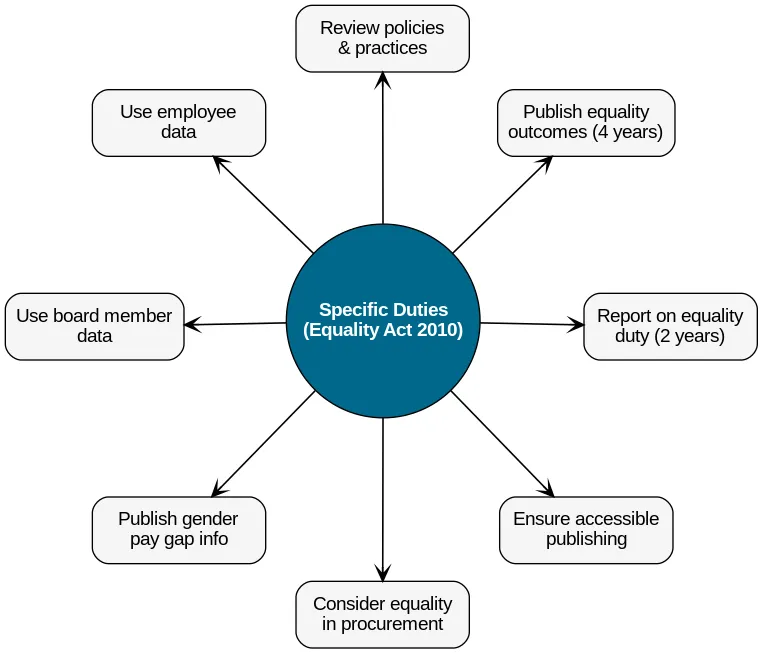
In addition to the PSED, the Act also imposes specific duties. The specific duties require that certain actions are taken by public authorities and are intended to assist public authorities to comply with the PSED. Some of the specific duties also require to be reported on and published in accordance with a reporting cycle of either two or four years. The specific duties are summarised below and also demonstrated (in summarised form) on the spider chart below:
- report on mainstreaming the equality duty (every two years)
- publish equality outcomes (every four years) and a progress report (every two years)
- assess and review policies and practices
- gather and use employee information
- use information on members or board members gathered by the Scottish Ministers
- publish gender pay gap information
- publish statements on equal pay
- consider award criteria and conditions in relation to public procurement
- publish in a manner that is accessible
Unlike the PSED, the specific duties do not apply to all public authorities. Only 'listed authorities', the public authorities set out in secondary legislation called 'Regulations' are required to comply with the specific duties. North Ayrshire Council and the North Ayrshire Council Licensing Board are both listed authorities.
1.3 North Ayrshire Council Licensing Board
The Board is constituted in terms of Section 5 of the Licensing (Scotland) Act 2005. The Board deals with the grant and regulation of licences for the sale and supply of alcohol. Certain gambling matters also fall within the Board's remit.
The Board is comprised of 10 elected members of the council. A Board must consist of at least five members. Board meetings are held in public but deliberations can be made in private. All Board decisions must be made in public. The Board is supported by a Clerk, a Depute Clerk and support staff. The council also employs a Licensing Standards Officer.
Despite having distinct legal personalities, the Licensing Board and the council are closely linked. The members of the Licensing Board are North Ayrshire Councillors who are elected by the council and the legal and administrative support provided to the Board is delivered by employees of the council. In addition to staff, the Board also shares the council's resources: Board meetings are held in the council's buildings and the Board uses the council's services and facilities to conduct its business on a day-to-day basis. The close connection and the sharing of resources between the Licensing Board and the council mean that the Board can benefit from actions undertaken by the council to advance equality and comply with the specific duties.
Elected members on the Board have the same opportunities as any other Councillors to receive equalities training. As council employees, the staff who support the work of the Board can all receive training on equalities in accordance with the council's equalities policies. Those involved in policy development and review are able to access training. When reports or other documents raising policy issues are prepared for the Board (for example the Licensing Policy Statements required under both pieces of primary legislation), these are accompanied by Equality and Children's Rights Impact Assessments.
Many of the actions described in the Joint Ayrshire Report and the council's Mainstreaming Report apply equally to the Licensing Board and its discharge of the specific duties as a listed authority. In particular, any actions undertaken by the council in respect of its employees and access to council services and facilities apply equally to the Licensing Board. Similarly, as all members of staff who assist the Board are employed by the council, the council's Mainstreaming Report sets out how the Licensing Board is meeting the requirement to gather and use employee information, to publish gender pay gap information and to publish statements on equal pay.
The report sets out how the Board is meeting its duties in terms of equality and diversity legislation. In addition to the Public Sector Equality Duty set out, the Board has objectives laid down in statute specifically related to work around which the Board must organise all of its licensing functions.
The work of the Board in these two areas (alcohol licensing and gambling licensing) is underpinned by principles called 'Licensing Objectives'.
Alcohol
The objectives under alcohol licensing are:
- preventing crime and disorder
- securing public safety
- preventing public nuisance
- protecting and improving public health
- protecting children (ages zero to 15) and young persons (aged 16 and 17) from harm
Gambling
The objectives held within gambling licenses are:
- preventing gambling from being a source of crime or disorder, being associated with crime or disorder or being used to support crime
- ensuring that gambling is conducted in a fair and open way
- protecting children (aged zero to 15) and other vulnerable persons from being harmed or exploited by gambling
The Gambling Act 2005 does not itself extend the Licensing Objective to the protection of young persons (aged 16 and 17), but in North Ayrshire the Board has done this by including young persons in the definition of 'vulnerable persons' in its Licensing Policy Statement.
2. Mainstreaming Equality
The Board is committed to embedding equality, diversity, and inclusion across all aspects of its work. Under the Act, public bodies have a legal duty to eliminate discrimination, advance equality of opportunity, and foster good relations between different groups. This applies to the Board's role in regulating alcohol and gambling licences, ensuring that policies and decisions do not disadvantage individuals or groups with protected characteristics, such as age, disability, gender, race, religion, care experienced or sexual orientation. The Board recognises that licensing plays a key role in public safety, community well-being, and economic activity, and that fair and inclusive licensing policies contribute to a more equitable and accessible society.
To achieve this, the Board takes a mainstreaming approach, meaning that equality considerations are not treated as a separate issue but are fully integrated into policy development, decision-making, and service delivery, for example, the Board's Licensing Policy Statement has equality built into the policy itself which reflects the overall position to prevent discrimination. Rather than being seen as an additional or optional step, equality is built into the Board's processes, procedures, and priorities from the outset. This ensures that licensing policies and conditions proactively promote inclusivity and social responsibility, rather than simply reacting to discrimination or inequality after issues arise. Mainstreaming also requires a culture of awareness and accountability, where Board members and staff continuously consider how their decisions and policies impact different groups within the community.
The Equality and Human Rights Commission (EHRC) provides guidance on mainstreaming the Public Sector Equality Duty (PSED), emphasising that equality should be a proactive, continuous process rather than a reactive or one-off action. This means ensuring that equality considerations influence the way licensing policies are developed, decisions are made, and services are delivered. The EHRC highlights the importance of embedding equality at a strategic level, using tools such as Equality and Children's Rights Impact Assessments (ECRIA) to assess the potential impact of policies on different groups and ensuring that public bodies engage meaningfully with stakeholders to inform their decision-making.
The specific public sector duty requires the Board to publish a report on progress made in integrating the equality duty into the Board's activities and functions. This must show how mainstreaming equality has helped the Board achieve the key aspects of the equality duty outlined in the Act. To demonstrate mainstreaming in practice, the Board considers equality across key areas of its work, including licensing policies, licence conditions, ECRIA, community engagement, and training. Licensing policies are developed in consultation with the public and key stakeholders, ensuring they are inclusive and fair. Standard licence conditions help to promote accessibility and safeguard vulnerable individuals, while ECRIA ensure that the impact of licensing decisions on different groups is carefully assessed. The Board also engages with partners such as Police Scotland and is re-establishing the Licensing Forum to strengthen community input. Additionally, ongoing training ensures that Board members and staff remain aware of their responsibilities under equality law.
By taking a structured, evidence based approach to mainstreaming equality, the Board ensures that its licensing system supports fairness, transparency, and inclusivity, benefiting both businesses and the wider community.
2.1 Mainstreaming in Practice
The Board deals with the administration and enforcement of the Licensing provisions of the above Acts including the processing of applications, considering complaints, the provision of information and advice to prospective applicants and members of the public and the preparation and submission of reports to the Board. The specific steps taken by the Board are considered below under the following headings:
- licensing policies
- licence conditions
- Equality and Children's Rights Impact Assessments
- community engagement and consultation
- training and awareness
Licensing policies
As part of the Board's commitment to upholding the principles under the Act, the Board exercises its functions in accordance with its licensing policies which promote fairness, inclusivity and non-discrimination. The Board has two main policies in this regard:
- Licensing Policy Statement adopted under Section 6 of the Licensing (Scotland) Act 2005
- Statement of Principles in terms of Section 349 of the Gambling Act 2005
The Board's Licensing Policy Statement acknowledges the importance of equality in regulating alcohol sales, aiming to create a safe and welcoming environment for all individuals, regardless of their background. It considers the impact of licensing decisions on vulnerable groups and seeks to mitigate any potential inequalities, aligning with the broader objectives of public safety, crime prevention, and public health. Additionally, the Board recognises the need to consider protected characteristics when granting, reviewing, or enforcing licences, ensuring that no individual or group faces disproportionate disadvantages due to its policies.
In relation to gambling, the Statement of Principles reinforces the Board's commitment to promoting social responsibility and preventing harm. The Board takes an evidence-based approach to licensing gambling establishments, ensuring that policies do not inadvertently contribute to inequalities, particularly among individuals who may be more vulnerable to gambling-related harm.
A key focus is placed on protecting children and those at risk of exploitation, as well as ensuring that gambling premises operate fairly and transparently. In line with the Act, the Board also strives to ensure that its processes are accessible to all, taking into account the needs of individuals with disabilities and other protected characteristics. By embedding equality considerations into its licensing and regulatory framework, the Board demonstrated a proactive approach to fostering inclusivity and fairness in the local community.
Licence conditions
The Board applies standard licence conditions as a key mechanism for ensuring that all licensed premises operate responsibly and in line with the Board's commitment to equality and mainstreaming under the Act. Licensing plays a crucial role in shaping the social and economic landscape of local communities, and by embedding equality considerations within licensing conditions, the Board seeks to create an environment that is safe, inclusive and accessible to all. The mainstreaming of equality within licensing policy ensures that no individual or group is disadvantaged as a result of the way premises are operated, and that the benefits of a well-regulated licensing regime are shared fairly across North Ayrshire's diverse communities.
Standard licence conditions set out clear expectations for licence holders, ensuring that premises operate in a way that aligns with the principles of fairness, public safety and non-discrimination. These conditions typically cover a range of operational areas, including staff training, security measures, accessibility, and the protection of vulnerable individuals. For example, all staff working in licenced premises must be trained to understand their legal responsibilities, including the importance of preventing underage sales, identifying and responding to vulnerability, and ensuring that all customers are treated with dignity and respect. This training requirement not only enhances compliance with licensing laws but also helps to promote a culture of awareness, inclusivity, and responsibility within the licensed trade. The training requirements are laid out in the Licensing (Scotland) Act 2005 and are monitored by the Board's Licensing Standards Officer (LSO) to ensure compliance with the legislation.
A key focus of the Board's mainstreaming approach is ensuring that licensed premises are inclusive and accessible to people with disabilities and those with other protected characteristics. Standard licence conditions support this goal by requiring licence holders to consider physical accessibility, communication needs, and the provision of assistance where necessary. For example, premises are expected to comply with accessibility standards for wheelchair users, provide clear signage, and ensure that staff are trained to assist customers who may require additional support, which is again monitored by the Board's LSO. In doing so, the Board ensures that people with disabilities can access and enjoy licensed premises without facing unnecessary barriers or discrimination.
The Board also recognises that some individuals may experience social or economic disadvantage, which can affect their ability to safely access and engage with licensed premises. As part of its commitment to mainstreaming equality, the Board seeks to ensure that licensing conditions do not disproportionately impact any group, particularly those who may be more vulnerable to harm. This includes ensuring that standard conditions do not unintentionally exclude individuals from employment or participation in the licensed trade due to factors such as age, disability or socio-economic status.
In line with the Board's commitment to public protection, standard licence conditions place a strong emphasis on safeguarding children and other vulnerable individuals from harm. Premises are required to have robust age verification procedures in place to prevent underage access to alcohol or gambling, helping to reduce the risk of harm to young people. Additionally, staff must be trained to recognise and respond to indicators of vulnerability, such as intoxication, financial hardship, or coercive behaviour, ensuring that appropriate interventions can be made when necessary.
The Board also works to ensure that licensing conditions support responsible business practices that minimise the potential for harm. For example, licensed premises may be required to implement measures such as CCTV, incident recording, and responsible service policies to deter crime and disorder while also promoting community safety. In the context of gambling, premises must have policies in place to support responsible gambling, including self-exclusion schemes, clear signage about gambling risks, and staff training on recognising problem gambling behaviours. These conditions reflect the Board’s broader mainstreaming objectives by ensuring that vulnerable individuals are protected from exploitation or harm.
Another key aspect of the Board’s equality and mainstreaming approach is ensuring that the licensing process itself is fair, transparent, and accessible to all. The Board is committed to making sure that licence applications, reviews, and enforcement actions are conducted in a way that is free from bias and discrimination, ensuring that all applicants and licence holders are treated equitably. Standard conditions provide clarity and consistency in how licensing decisions are made, helping to reduce the risk of unfair treatment or arbitrary decision-making.
Additionally, the Board takes proactive steps to ensure that licensing information is readily available and accessible to everyone, including those for whom English may not be their first language or who may require additional support to engage with the process. This includes making guidance documents available in alternative formats, ensuring that hearings and consultations are conducted in an inclusive manner, and working with stakeholders to promote greater engagement from underrepresented groups.
The North Ayrshire Licensing Board recognises that equality mainstreaming is an ongoing process and that standard licence conditions must be regularly reviewed and updated to reflect emerging risks, legislative changes, and best practices. The Board takes a proactive approach to monitoring and evaluating the impact of licensing conditions to ensure that they continue to support the objectives of the Act. This includes working in partnership with local communities, public health agencies, law enforcement, and advocacy groups to identify areas where conditions may need to be strengthened or adapted to better serve the needs of all residents.
By embedding equality into the development and enforcement of standard licence conditions, the Board ensures that licensing policy remains fair, effective, and inclusive. This approach not only supports local businesses and community safety but also reinforces the Board’s wider commitment to eliminating discrimination, promoting equal opportunities, and fostering good relations between different groups within North Ayrshire. Through this work, the Board plays a crucial role in ensuring that licensing contributes positively to the social, economic, and cultural well-being of the local area, in line with the principles of equality and mainstreaming.
Equality and Children's Rights Impact Assessments
As part of its commitment to mainstreaming equality under the Act, the Board integrates Equality and Children’s Rights Impact Assessments (ECRIA) into its decision-making processes. ECRIAs are a vital tool for ensuring that the Board’s policies, practices, and licensing decisions do not discriminate against any individual or group and that they actively contribute to the promotion of equality and inclusion. By systematically assessing the potential impact of its licensing policies, the Board ensures that all individuals (regardless of their protected characteristics) have fair and equal access to licensed premises and services within North Ayrshire.
ECRIAs allow the Board to identify and address any potential barriers or unintended consequences of its policies on different groups within the community. For example, when reviewing its Licensing Policy Statement or considering amendments to standard licence conditions, the Board proposes to conduct an ECRIA to assess how these policies might affect individuals with protected characteristics, such as those with disabilities, older people, or those from different racial and ethnic backgrounds. If a policy was to be found to disproportionately disadvantage a particular group, the Board would take steps to mitigate these impacts, either by amending the policy, introducing additional support measures, or providing guidance to licence holders on how to ensure compliance with equality principles.
By embedding ECRIAs into its policy development process, the Board ensures that its licensing framework remains responsive to the needs of North Ayrshire’s diverse population. This approach aligns with its mainstreaming obligations by ensuring that equality is not treated as an afterthought but rather as a core consideration in every licensing decision.
A key aspect of mainstreaming equality through ECRIA is ensuring that the assessment process is transparent and inclusive. The Board is committed to engaging with community groups, advocacy organisations, and members of the public to gather a wide range of perspectives on how licensing policies and decisions affect different groups. This engagement ensures that ECRIAs are not simply a bureaucratic exercise but rather a genuine opportunity to listen to and address community concerns.
Where ECRIAs identify potential negative impacts, the Board considers how these can be mitigated or eliminated, working in partnership with other agencies, such as public health services, law enforcement, and equality organisations. Additionally, by publishing ECRIA findings where appropriate, the Board ensures accountability and openness in its decision-making, allowing the public to see how equality considerations have shaped licensing policies and practices.
The North Ayrshire Licensing Board recognises that equality mainstreaming is an ongoing process and that ECRIAs must be continuously reviewed and improved to remain effective. The Board is committed to regularly evaluating the impact of its licensing policies and conditions, ensuring that they continue to align with the principles of fairness, accessibility, and inclusivity. By taking an adaptive approach, the Board ensures that its licensing framework evolves in response to emerging equality issues, demographic changes, and shifts in community needs.
Through the integration of Equality and Children’s Rights Impact Assessments, the Board reinforces its commitment to embedding equality at the heart of licensing regulation. This approach not only helps to eliminate discrimination and promote equal opportunities but also ensures that the licensing system contributes positively to the social and economic well-being of North Ayrshire’s communities. By using ECRIAs as a tool for inclusive decision-making, the Board continues to uphold its duty to mainstream equality across all aspects of its work, ensuring that licensing policies support a fair, safe, and diverse society.
Community engagement and consultation
As part of its commitment to mainstreaming equality, the Board recognises the importance of engaging with key stakeholders and the wider community to ensure that licensing policies and decisions are fair, transparent, and inclusive. Meaningful consultation helps the Board to understand the potential impact of licensing on different groups, particularly those with protected characteristics under the Act. By incorporating a range of perspectives into its decision-making processes, the Board ensures that licensing policies and practices reflect the needs of the community while upholding the principles of equality, fairness, and accessibility.
The Board carries out formal consultation as part of the licensing process. When considering applications for new licences, variations, or reviews, the Board seeks input from statutory consultees, including Police Scotland, to assess the impact on crime prevention, public safety, and the protection of vulnerable individuals. Additionally, when developing or reviewing key policies (such as the Licensing Policy Statement or the Statement of Principles for Gambling) the Board conducts public consultations to invite feedback from businesses, residents, and community organisations. This allows for wider participation in shaping licensing policy and ensures that potential equality concerns are identified and addressed at an early stage.
To further enhance community engagement, the Board is in the process of re-establishing a Licensing Forum, which will include representatives from a range of sectors, such as the licensed trade, public health, Police Scotland, and local community groups. The Forum will serve as an advisory body, providing insights into how licensing policies affect different sections of the community and offering recommendations on improving inclusivity and social responsibility in licensed premises. By re-establishing this Forum, the Board aims to create a structured and ongoing dialogue between key stakeholders, ensuring that equality considerations remain at the forefront of licensing discussions.
While formal consultation is a crucial part of the licensing process, the Board is also committed to continuous improvement in how it engages with underrepresented groups. Going forward, there is an opportunity to explore wider outreach efforts, including engagement with organisations that support individuals with disabilities, minority ethnic communities, and those affected by alcohol or gambling-related harm. By broadening the scope of engagement, the Board can strengthen its commitment to mainstreaming equality, ensuring that the voices of all residents are considered in the licensing system.
Through its consultation processes and the re-establishment of the Licensing Forum, the Board reinforces its commitment to inclusive, transparent, and fair decision-making. By listening to and acting upon the concerns of local communities and key stakeholders, the Board ensures that licensing policies support public safety, economic growth, and social responsibility, while also aligning with its equality and mainstreaming objectives.
Training and awareness
To support the effective mainstreaming of equality and diversity, the Board recognises the importance of ensuring that Board members, staff, and key stakeholders are properly trained and informed about their responsibilities under the Act. Training is essential in ensuring that licensing decisions are made fairly, consistently, and without discrimination, while also promoting an awareness of the potential impact that licensing policies and conditions may have on individuals with protected characteristics.
Board members receive ongoing training from the council’s Equalities Inclusion Officer on their statutory responsibilities, including their obligations under equality legislation and the importance of considering equality impacts when making licensing decisions. This ensures that decisions are objective, evidence-based, and free from bias, helping to create a licensing framework that is fair and inclusive. Training also covers areas such as unconscious bias, accessibility considerations, and the impact of licensing on vulnerable individuals, ensuring that Board members take an informed and balanced approach when assessing applications or reviewing policies.
In addition to training for Board members, staff involved in processing applications and enforcing licensing conditions also receive guidance on equality considerations. This includes training on how to interact with diverse communities, identify potential discrimination risks, and ensure that all applicants and licence holders are treated equitably. By equipping staff with this knowledge, the Board ensures that licensing processes remain transparent, accessible, and inclusive for all individuals, regardless of their background.
Furthermore, the Board acknowledges the importance of raising awareness among licence holders about their responsibilities under equality legislation. While compliance with standard licence conditions already requires premises to operate responsibly, additional training and guidance for licence holders (particularly around preventing discrimination, supporting accessibility, and safeguarding vulnerable individuals) can help reinforce good practice within the licensed trade. Where appropriate, the Board works with partner organisations to provide information and resources that assist licence holders in understanding their equality obligations.
By prioritising training and awareness, the Board ensures that equality is embedded into all aspects of its licensing functions, from policy development to decision-making and enforcement. This proactive approach helps to ensure that the Board not only meets its statutory obligations but also promotes a culture of inclusivity, fairness, and respect within the licensing system.
2.2 Monitoring progress and future commitments
The Board recognises that mainstreaming equality is an ongoing process that requires regular monitoring, evaluation, and continuous improvement, in addition to its specific statutory reporting duties. Embedding equality within licensing is not a one-time action but a continuous commitment to ensuring that policies and decisions remain fair, inclusive, and non-discriminatory. This means regularly assessing how licensing policies impact different groups, engaging with stakeholders to identify concerns, and making necessary adjustments to ensure that the licensing framework supports the needs of all individuals, businesses, and communities.
A key part of this commitment is the review of licensing data and trends. The Board monitors how licensing decisions affect different groups within the community and considers whether any trends indicate potential inequality or unintended negative consequences. Where possible, data will be analysed in relation to protected characteristics, such as age, disability, or gender, to identify any disparities in how licensing policies are applied or decisions on specific applications are made. For example, the Board will consider statistics and its Overprovision Policy in the decision-making process of Premises Licence applications. This allows the Board to take proactive steps to address potential inequalities before they become more significant issues. The use of ECRIAs is central to this approach. These assessments help the Board to identify, assess, and mitigate any adverse effects of licensing policies on different groups, ensuring that equality considerations are embedded within the decision-making process. Crucially, ECRIAs are not static documents, they are reviewed and updated in response to new information, ensuring they remain relevant and effective over time.
Another important element of monitoring progress is stakeholder engagement. The Board regularly consults with key statutory partners, such as Police Scotland and Health Board representatives, to ensure that licensing policies reflect wider public interest considerations, including the protection of vulnerable individuals. Beyond statutory consultation, the Board is also focused on broadening its engagement with the wider community, ensuring that diverse voices are reflected in licensing decisions. The re-establishment of the Licensing Forum is a crucial step in this direction, as it will provide a structured platform for discussion and feedback from representatives of the licensed trade, community groups, and other relevant stakeholders. This Forum will help to ensure that the Board remains responsive to emerging concerns, while also offering a space for constructive dialogue on how licensing policies can continue to promote fairness and inclusion.
Looking ahead, the Board is committed to enhancing training and awareness for both its members and staff. While training on equality and accessibility is already embedded into the Board’s development framework, the Board will explore ways to expand and update these learning opportunities. This could include more in-depth training on specific protected characteristics, ensuring that Board members have a deeper understanding of how licensing policies may affect different groups in different ways. Training could also be expanded to cover new developments in equality legislation and best practices from other licensing authorities, ensuring that the Board remains at the forefront of fair and inclusive decision-making.
The Board also recognises the importance of data collection and analysis in strengthening its approach to equality mainstreaming. By improving how it gathers and uses equality-related data, the Board can develop more evidence-based policies and ensure that licensing conditions remain proportionate, effective, and responsive to community needs. This could involve exploring new ways to gather feedback from licensees, community members, and equality groups, as well as assessing whether certain licensing requirements disproportionately affect specific groups. The insights gained from this work will enable the Board to refine its approach to equality mainstreaming, ensuring that policies continue to reflect best practice and legal obligations.
Finally, the Board is committed to ongoing policy review and refinement to ensure that its approach to licensing remains inclusive, adaptable, and aligned with evolving societal needs. As part of this, future licensing policy reviews will take into account changing demographics, emerging equality challenges, and feedback from public consultations. This will help ensure that the Board continues to take a proactive approach to equality rather than simply responding to concerns when they arise. The Board will also seek to learn from best practices across Scotland and beyond, ensuring that its policies reflect the most effective and forward-thinking approaches to inclusive licensing.
By maintaining a structured and evidence-based approach to monitoring progress and planning for the future, the Board ensures that its licensing framework remains fair, transparent, and inclusive. This ongoing commitment benefits both businesses and the wider community, ensuring that licensing continues to contribute to a safe, diverse, and accessible environment for all.3.
3. Equality Outcomes
While mainstreaming equality ensures that fairness, inclusivity, and non-discrimination are embedded across all aspects of the North Ayrshire Licensing Board’s work, setting specific equality outcomes provides a clear framework for measuring progress and driving meaningful change. The Board operates within the requirements of the Public Sector Equality Duty (PSED), which places a legal obligation on public bodies to eliminate discrimination, advance equality of opportunity, and foster good relations between individuals with different protected characteristics. As part of this duty, the Board is required to develop and implement equality outcomes, measurable goals designed to improve experiences and remove barriers for those who may face disadvantage within the licensing system.
An equality outcome differs from broader commitments to equality in that it is a targeted, results-driven objective aimed at achieving specific, positive change for people who share protected characteristics under the Equality Act 2010 ('the Act'). While mainstreaming ensures that equality considerations are consistently applied across policies, processes, and decision-making, equality outcomes take this a step further by setting defined priorities and tracking progress over time. These outcomes help to ensure that the Board’s efforts to promote equality are not just passive or reactive, but proactive and strategic, addressing areas where disparities exist and where improvements can be made.
The process of setting equality outcomes involves careful consideration of local needs, engagement with key stakeholders, and alignment with national equality priorities. In developing these outcomes, the Board has drawn upon insights gained through its licensing policies, standard licence conditions, Equality and Children’s Rights Impact Assessments (ECRIA), and consultation with organisations such as Police Scotland and community representatives. The outcomes have also been shaped by the Board’s commitment to training and awareness-raising, ensuring that members and staff are well-equipped to make decisions that support fairness, accessibility, and inclusivity.
Additionally, the equality outcomes take into account wider social and economic factors that may influence licensing. The Board recognises that licensing decisions have real-world implications, from ensuring that licensed premises are welcoming and safe for all individuals to addressing the potential disproportionate impact of alcohol and gambling on certain groups. By setting focused equality outcomes, the Board can work towards making sure that the licensing system serves all communities equitably, supporting responsible business growth while also safeguarding those who may be more vulnerable to harm.
These equality outcomes are not static and they will be subject to ongoing monitoring and periodic review to ensure they remain relevant and effective. As part of this process, the Board will continue to engage with stakeholders, review equality data, and assess how well its policies are meeting the needs of different groups. The following section presents the Board’s equality outcomes in table format, setting out the intended aims, key actions, and methods for monitoring progress. This structured approach ensures that the Board remains accountable for its equality commitments and continues to work towards a more inclusive licensing framework for North Ayrshire.
3.1 North Ayrshire Licensing Board Equality Outcomes
The Board has set equality outcomes to ensure its licensing policies and decisions actively promote fairness, accessibility and inclusion. These outcomes align with the Board’s PSED obligations and address key areas where positive change can be made.
The information below outlines each outcome, along with the key actions and measures for tracking progress. These will be regularly reviewed to ensure they remain effective and relevant to the needs of North Ayrshire’s communities.
Licensed premises are accessible and inclusive for all individuals, including those with disabilities.
Relevant protected characteristics
- disability
- age
- race
- pregnancy and maternity
PSED duty area
Advance equality of opportunity.
Key actions
- encourage licence holders to adopt accessibility best practices
- consider accessibility requirements when setting licence conditions
The Board's policies and practices reflect the views of unrepresented groups.
Relevant protected characteristics
All protected characteristics relate to this outcome.
PSED duty area
Foster good relations and advance equality of opportunity.
Key actions
- re-establish the Licensing Forum with diverse representation
- ensure public consultations on licensing policies are widely promoted through various channels to promote maximum participation
The Board's decision-making processes are fair, transparent and consider equality implications.
Relevant protected characteristics
All protected characteristics relate to this outcome.
PSED duty area
Eliminate discrimination and advance equality of opportunity.
Key actions
- ensure Equality and Children's Rights Impact Assessments (ECRIA) are conducted for all major policy decisions
- provide plain language summaries of licensing decisions to make them more accessible to the public
- encourage applicants to demonstrate how they will promote equality within their premises as part of the licensing process
3.2 Monitoring and reporting on progress
The North Ayrshire Licensing Board is committed to ensuring that its equality outcomes remain effective in promoting fairness, transparency, and inclusivity. In line with the PSEDs, the Board is required to publish a progress report every two years. This report will assess the steps taken towards achieving the identified equality outcomes and will highlight areas where further action may be needed.
To support this, the Board will:
- review and analyse relevant data collected through engagement with stakeholders, licensing compliance checks, and Equality and Children's Rights Impact Assessments
- engage with key stakeholders, including Police Scotland, public health bodies, and equalities organisations, to gather feedback on how licensing policies and decisions are impacting different groups
- monitor key indicators of progress for each equality outcome, assessing whether actions taken are leading to measurable improvements
- ensure transparency by publishing the progress report online and making it accessible to the public and interested organisations
- use findings to inform future policy and practice, making adjustments to licensing processes and conditions where necessary to better support equality and inclusion
The Board will also ensure that, at the end of each four-year cycle, the equality outcomes are fully reviewed and refreshed, taking into account any legislative changes, emerging equality issues, and feedback from stakeholders. This approach will ensure that equality considerations remain embedded in the Board’s decision-making and regulatory responsibilities.
4. Sustaining progress on equality
The North Ayrshire Licensing Board remains committed to promoting equality, fairness, and transparency in all aspects of its licensing responsibilities. This report has outlined how the Board is mainstreaming equality into its policies, decision-making processes, and engagement with the community. It has also set out clear equality outcomes designed to advance fairness and inclusivity across North Ayrshire’s licensing framework. However, equality is not a one-off commitment, it requires continuous improvement, ongoing dialogue with stakeholders, and regular reflection on the effectiveness of policies and practices.
Over the next two years, the Licensing Board will focus on building upon the progress already made and strengthening its approach to equality in the following key areas:
- monitoring and reviewing progress - the Board will ensure that the Equality Outcomes remain relevant and effective by regularly reviewing progress and addressing any emerging equality challenges. The statutory two-year progress report will provide a transparent update on achievements and areas for improvement
- enhancing engagement and consultation - efforts will continue to ensure that all communities have a voice in shaping licensing policies. The Board will work to increase participation from underrepresented groups in consultations and enhance accessibility to decision-making processes
- improving training and awareness - the Licensing Board is committed to expanding training opportunities for its members and staff, ensuring they remain well-informed on equality legislation, unconscious bias, and inclusive decision making
- strengthening data collection and evidence-based decision-making - the Board will explore ways to gather better equality related data to assess how licensing policies impact different groups, ensuring that decision-making is informed, fair and inclusive
- embedding equality further in licensing policy - the Board will continue to review and refine its policies, ensuring that licensing conditions, guidance, and enforcement practices align with its commitment to equality and non-discrimination
4.1 Final remarks
The Board recognises that licensing decisions play a crucial role in shaping safe, inclusive, and fair communities. By embedding equality considerations into its core functions, the Board aims to create a licensing framework that promotes public safety, supports diversity, and ensures fair access to licensed services for all residents.
The Board remains committed to ongoing learning and adaptation, responding to the needs of the community and working collaboratively with key stakeholders to ensure that licensing policies continue to uphold the principles of fairness, transparency, and equality.
As the Board moves forward, it will continue to listen, engage, and evolve, ensuring that its work reflects the diverse needs of North Ayrshire’s communities while meeting its statutory duties under the Equality Act 2010. Through proactive engagement, robust decision-making, and a commitment to equality, the Licensing Board will strive to create a licensing system that is not only legally compliant but also inclusive, responsive, and reflective of the values of equality and fairness.