 Translate
Proposed for consultation at Licensing Board on 7 September 2026.
Part 1 - Purpose and legal status
1.1 What this profile is for
The Gambling Commission recommends that licensing authorities prepare a Local Area Profile (LAP). Its purpose is to describe actual and emerging local factors that may be relevant to the three gambling licensing objectives. It should help operators prepare better premises applications and help the Board make fair, evidence-based decisions.
This is the initial North Ayrshire LAP supporting the Board's replacement Statement of Principles for the current statutory period ending on 30 January 2028. The LAP is not itself required by statute and does not replace the Gambling Act 2005, the Commission's codes or guidance, or the Board's Statement of Principles.
1.2 How it should be used
The LAP is a starting point and should be used as follows:
- An operator should use it with current observations of the site, the proposed operation, the premises plan, staff and incident information, and any relevant engagement.
- Only factors that have a rational connection to the particular premises and a licensing objective should be carried into the operator's local risk assessment.
- The Board will consider the operator's explanation and controls and will decide every application or review on its own facts.
1.3 Legal limits
For premises decisions, section 153 of the Gambling Act 2005 requires the Board to aim to permit gambling so far as it considers the application to be in accordance with the Commission's codes and guidance, reasonably consistent with the licensing objectives, and in accordance with the Board's Statement of Principles.
The LAP cannot create a public-health licensing objective, a demand test, a quota, a cumulative-impact policy, a fixed exclusion zone or a presumption against premises in a particular area. Deprivation, health data or the number of existing premises cannot by themselves justify refusal or a condition. The LAP is not a statutory gambling impact assessment and does not import an England-and-Wales regime into Scotland.
The profile is most likely to assist with the objective of protecting children and other vulnerable persons from being harmed or exploited by gambling. Evidence may also be relevant to crime and disorder or to fair and open gambling, but only where the link is explained.
Gambling Commission guidance on local area profiles.
Part 2 - Definitions and how to read the data
2.1 Abbreviations
The document uses only the abbreviations listed below. Where a term appears only once, it is written out in full.
| Abbreviation | Meaning |
|---|---|
| GIS | Geographic Information System - digital mapping used to show locations and surrounding features. |
| HSCP | Health and Social Care Partnership - the partnership responsible for integrated health and social-care services locally. |
| LAP | Local Area Profile. |
| LCCP | Licence Conditions and Codes of Practice published by the Gambling Commission. |
| LIST | Local Intelligence Support Team within Public Health Scotland. |
| PGSI | Problem Gambling Severity Index - a survey screening scale based on gambling behaviour and reported consequences; it is not a clinical diagnosis. |
| PHS | Public Health Scotland. |
| SIMD | Scottish Index of Multiple Deprivation - Scotland's small-area measure of relative deprivation. |
2.2 Key terms
Licensing objectives. Preventing gambling from being a source of crime or disorder, associated with crime or disorder, or used to support crime; ensuring gambling is conducted fairly and openly; and protecting children and other vulnerable persons from harm or exploitation by gambling.
Local risk assessment. The premises-specific assessment required by LCCP social responsibility code 10.1.1. It identifies local risks to the licensing objectives and the policies, procedures and controls used to mitigate them.
Operator or licensee. The holder of the relevant Gambling Commission operating licence. In Part 5 it includes an applicant who must prepare an assessment for proposed premises.
Premises licence. A licence issued by the Board authorising specified gambling facilities at particular premises. The figures in this LAP do not include remote gambling or every other permit, notice or gambling permission.
Residual risk. The risk that remains after the operator's controls are taken into account.
Vulnerable persons. The Gambling Act 2005 does not provide a fixed definition. The Commission's guidance includes people who gamble more than they want to, gamble beyond their means, or may be unable to make an informed or balanced decision because of circumstances such as mental ill-health, a learning disability, or alcohol or drug use. Vulnerability must be considered in context and must not be assumed from a postcode, age, benefit status, disability or appearance.
2.3 How to read the figures
The statistics provide context. They are not a ranking of localities and they do not measure gambling harm.
- Percentages show the share of the relevant population. A difference between two percentages is described in percentage points, not as a percentage increase.
- A rate per 100,000 allows areas of different population size to be compared. It is not the actual number of people and, for hospital data, it represents recorded admissions rather than a finding about gambling.
- SIMD quintile 1 is the most deprived 20% of Scottish data zones; quintile 5 is the least deprived 20%. For example, 40.4% in SIMD quintile 1 means that about two in five North Ayrshire residents live in data zones within Scotland's most deprived fifth. It does not mean that every person in those areas is deprived.
- The mental-health prescribing figure is a broad population indicator. It does not identify a diagnosis, an individual customer or gambling-related harm.
- Locality figures are averages and can conceal substantial differences between neighbourhoods and streets.
- Premises figures are a dated snapshot of current Gambling Act premises licences. They do not measure customer numbers, expenditure, demand, online gambling or harm.
- An association between two indicators does not establish that one caused the other. A premises decision requires current, site-specific evidence and a link to a licensing objective.
Part 3 - North Ayrshire and its localities
3.1 North Ayrshire at a glance
The table gives an area-wide baseline. The population and health indicators come from the PHS/LIST North Ayrshire HSCP management profile dated 11 May 2026. They should be read using the explanations in Part 2.
| Indicator | North Ayrshire |
|---|---|
| Population | 134,010 |
| Aged 65 or over | 24.6% |
| Living in SIMD quintile 1 | 40.4% |
| Living in SIMD quintile 5 | 9.5% |
| Prescribed medication for anxiety, depression or psychosis | 23.8% |
| Alcohol-related hospital admissions | 554.4 per 100,000 |
| Drug-related hospital admissions | 221.1 per 100,000 |
North Ayrshire has a material deprivation and health context: about two in five residents live in SIMD quintile 1 areas and the profile reports material mental-health prescribing and hospital-admission indicators. Almost one in four residents is aged 65 or over. Those facts may prompt questions about financial vulnerability, accessibility, isolation, customer interaction and routes to support. They do not show that gambling caused the figures or that a particular customer or premises presents a risk.
3.2 Population and deprivation by locality
This table shows how the six localities differ in population, age profile and relative area deprivation. SIMD figures describe where people live; they do not classify individuals.
| Locality | Population | Aged 65+ | SIMD 1 | SIMD 5 |
|---|---|---|---|---|
| Arran | 4,630 | 34.8% | 0.0% | 0.0% |
| Garnock Valley | 19,557 | 22.6% | 40.1% | 7.0% |
| Irvine | 39,094 | 21.6% | 44.7% | 3.2% |
| Kilwinning | 15,688 | 21.5% | 54.5% | 7.7% |
| North Coast and Cumbraes | 23,484 | 34.1% | 8.6% | 29.3% |
| Three Town | 31,557 | 22.6% | 57.8% | 6.5% |
| North Ayrshire | 134,010 | 24.6% | 40.4% | 9.5% |
Three Towns and Kilwinning have the highest SIMD quintile 1 shares. North Coast and Cumbraes and Arran have older population profiles and much lower recorded SIMD quintile 1 shares. These contrasts may change the questions asked about a site, but lower area deprivation does not mean that no customer is vulnerable and an older population does not itself establish vulnerability.
3.3 Health context and premises count by locality
The admission rates below are per 100,000 population. The prescribing percentage and admission rates are general health indicators, not measures of gambling-related harm. The premises column is the July 2026 licensing-register snapshot.
| Locality | Mental health prescribing | Alcohol admissions | Drug admissions | Premises |
|---|---|---|---|---|
| Arran | 26.7% | 568.4 | 145.8 | 0 |
| Garnock Valley | 23.0% | 526.8 | 197.4 | 1 |
| Irvine | 25.2% | 532.6 | 250.3 | 9 |
| Kilwinning | 24.9% | 471.2 | 189.6 | 2 |
| North Coast and Cumbraes | 19.5% | 454.1 | 122.6 | 4 |
| Three Town | 26.4% | 756.1 | 289.3 | 11 |
| North Ayrshire | 23.8% | 554.4 | 221.1 | 27 |
Three Towns has the highest value for each of the three listed health indicators and the largest premises count. Irvine has the second-largest premises count and a drug-admission rate above the North Ayrshire figure. The other localities show different patterns: for example, Arran's alcohol-admission rate is slightly above the North Ayrshire rate despite having no current premises licence. This demonstrates why the figures cannot be treated as a causal link between premises and health outcomes.
3.4 Current premises landscape
At the evidence cut-off there were 27 current premises licences. The William Hill betting premises at 30 Eglinton Street, Beith had surrendered its licence and has been removed from the count and map. The map is an overview; the statutory register and the application plan remain authoritative.
The 27 premises comprise the following four licence types.
| Premises type | Count | Share of total |
|---|---|---|
| Betting | 15 | 55.6% |
| Adult gaming centre | 5 | 18.5% |
| Bingo | 5 | 18.5% |
| Licensed family entertainment centre | 2 | 7.4% |
What this tells us. Betting premises make up just over half of the current total. The proportions describe the current licence mix; they do not show customer numbers, expenditure, demand or harm.
Distribution by locality
Figure 2 compares each locality's share of North Ayrshire's population with its share of the 27 current premises licences. The two measures have been converted to percentages so that localities of different sizes can be compared on the same scale.
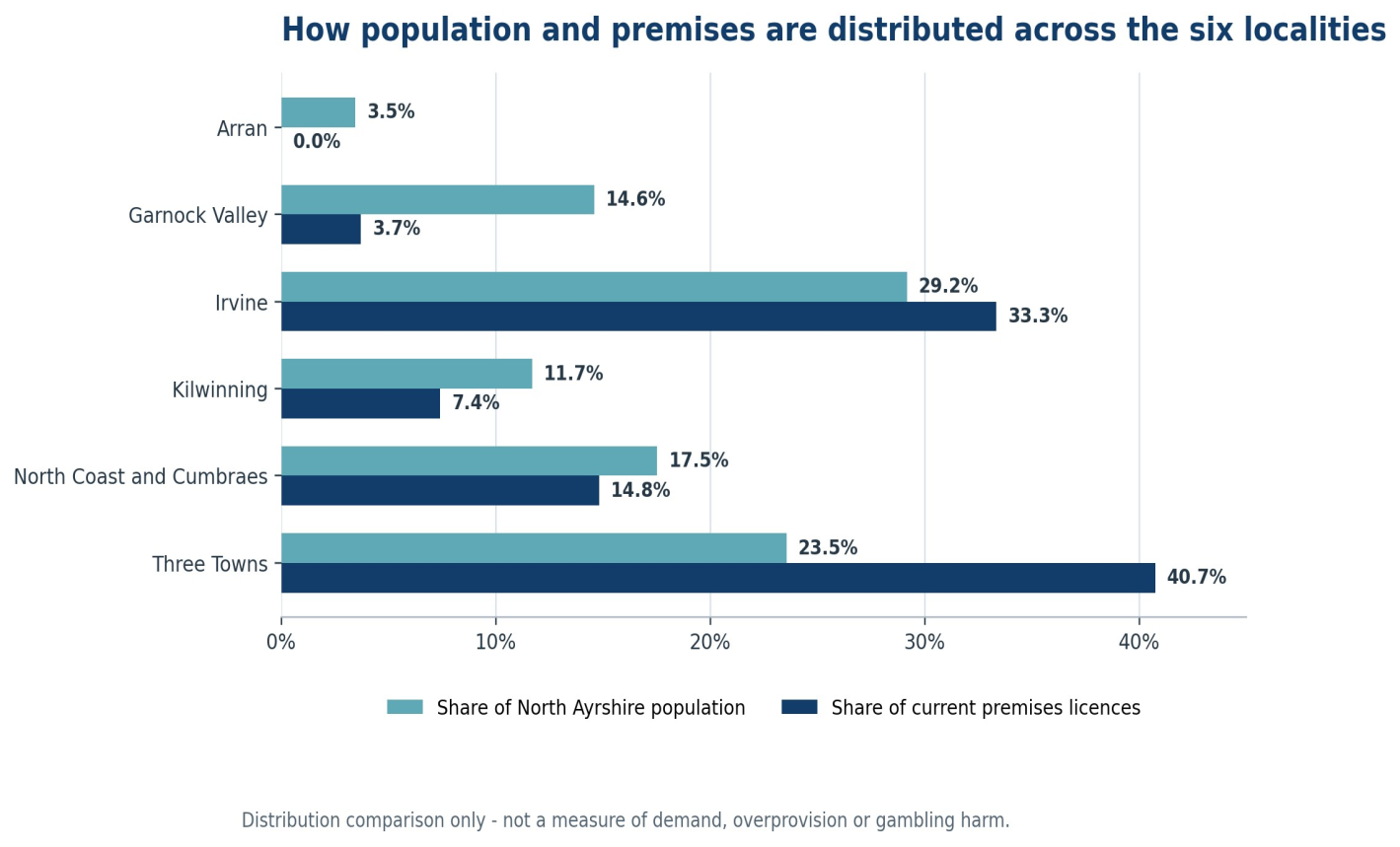
Three Towns and Irvine together contain 20 of the 27 licences (74.1%) while accounting for 52.7% of the North Ayrshire population. That is a description of where licences are located. It is not evidence of overprovision, unmet demand or gambling harm, and it cannot replace a premises-specific assessment.
2019 and 2026 snapshots
Figure 3 compares the total recorded in the Board's 2019 Statement with the reconciled licensing-register total at 22 July 2026. There are no annual observations between those dates, so the graphic is a comparison of two snapshots rather than a trend line.
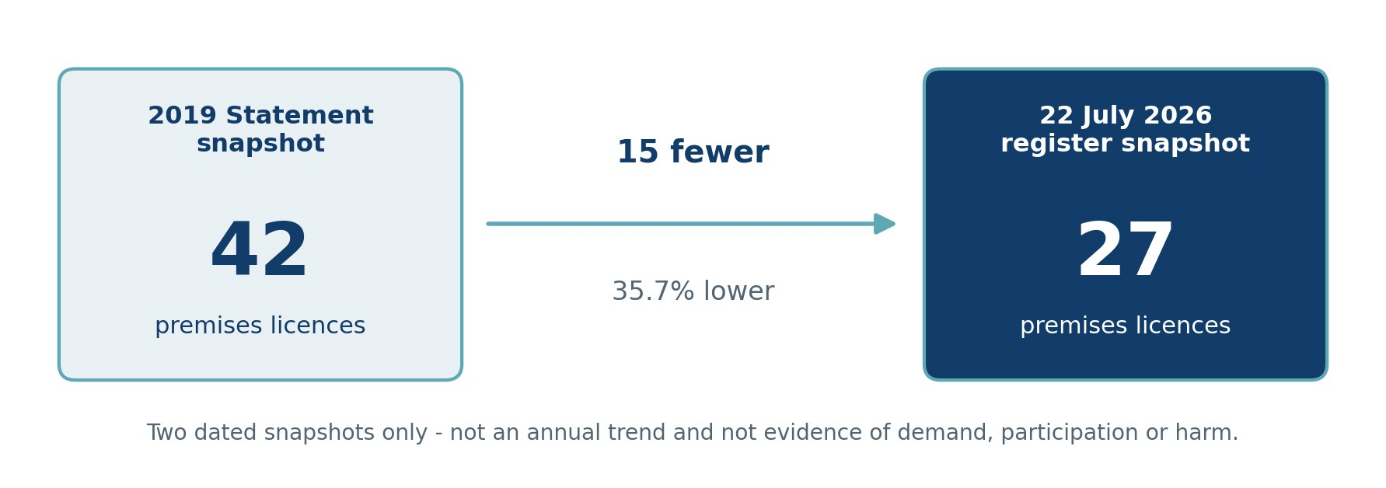
The recorded total is 15 lower than in the 2019 Statement, a reduction of 35.7%. The comparison does not explain when or why licences ceased, and it says nothing by itself about gambling participation, online gambling, demand or the level of harm.
3.5 What the locality figures mean in practice
The summaries below identify the main contrast in each locality and the question it may raise. They are not risk ratings and do not replace a visit to the proposed site.
Three Towns
It has the largest premises count and the highest listed SIMD quintile 1, mental-health prescribing, alcohol-admission and drug-admission figures. An assessment should therefore explain the actual site, child and family routes, customer interaction and any evidenced issues around the premises. It must not assume that the locality figures prove harm.
Irvine
It is the largest locality by population and has nine premises. Its averages conceal substantial neighbourhood variation, so an assessment should identify the particular street, surrounding uses and customer journey rather than relying on an Irvine-wide label.
Kilwinning
It has a high SIMD quintile 1 share and mental-health prescribing figure but two current premises. The data may raise questions about financial vulnerability and support, but it does not support a high-risk label or suggest that further capacity is available.
Garnock Valley
It has one current premises following the Beith surrender. An assessment must use the current register and the facts of the proposed site; the surrender does not demonstrate any change in demand or harm.
North Coast and Cumbraes
It has an older population profile, lower recorded SIMD quintile 1 share and four premises. Relevant site questions may concern seasonality, mixed-age leisure, transport, accessibility and access to support.
Arran
It has no current premises licence and an older population profile. A 0.0% SIMD quintile 1 figure does not mean there is no hardship or vulnerability. Any future application would need fresh evidence about the island location, seasonality, transport, staffing and support routes.
Part 4 - Local risk factors
4.1 Identifying a premises-specific risk
A useful risk assessment brings four things together:
- People - who may be affected, in what circumstances and why.
- Place - the actual routes, neighbouring uses, visibility, transport, footfall and seasonal features around the premises.
- Operation - the proposed gambling, machines, hours, access, layout, staffing, payments, advertising and customer journey.
- Controls - how the operator will prevent, detect, respond to, record and review the identified risk.
The assessment should state the possible harm, the licensing objective involved, the evidence, who may be affected, the likelihood and seriousness, the controls, and the residual risk.
4.2 Children and young people
Protecting children is a shared responsibility. In this LAP, the relevant group is children and young people exposed to gambling-related harm. The assessment should focus on their exposure, safety and wellbeing rather than adult consumer behaviour.
Exposure to gambling-related harm may form part of wider exploitation or coexist with other safeguarding concerns. Evidence may raise questions about financial exploitation or scams; coercion by peers or older people; debt or other addictions; intergenerational gambling; family conflict or domestic abuse; anxiety, loneliness, isolation or self-harm; and absence from school. These are prompts for enquiry, not findings about a child, household, neighbourhood or premises.
Schools, nurseries, colleges, youth services, community campuses, libraries, leisure facilities, family-focused areas and routes used by children may be relevant to access, visibility, advertising, exposure or supervision. Digital or gambling-adjacent activity, including social-casino games, randomised rewards, online gaming features and speculative trading apps, may provide context. Many such products fall outside the Board’s premises remit, so the assessment must identify the evidence that connects the concern to the particular premises and a licensing objective. There is no fixed buffer distance.
An operator should observe routes and footfall at relevant times and explain how the entrance, frontage, advertising, layout, staffing, age verification and separation of adult and family activity address the site-specific risk. North Ayrshire Child Protection Committee partner input dated 1 June 2026 informed these prompts. Its Chair supports the proposed section 157(h) role in principle; formal Committee and Public Protection Chief Officers Group decisions remain to follow.
4.3 Financial vulnerability
The Council-supplied DWP Xplore tracker, labelled ‘Children in Low Income Families: After Housing Costs — Relative Low Income’, records 4,753 of 24,260 North Ayrshire children aged 0 to 17 in low-income families in 2024/2025. That is 19.6%, or roughly one in five. The corresponding 2023/2024 figures were 4,845 and 20.0%, a decrease of 92 children and 0.4 percentage points.
The 2024/2025 intermediate-zone figures range from 6.7% to 36.3%. The highest figures in the supplied table are Irvine Fullarton at 36.3% and Stevenston Hayocks at 32.2%. This variation may help identify questions for a particular site; it is not a ranking of communities or evidence that gambling premises caused financial harm.
Staff should respond to observed behaviour and disclosed circumstances through suitable customer-interaction, self-exclusion, signposting and escalation procedures. Customers must not be stereotyped by postcode, benefits, appearance or protected characteristic.
The Child Poverty Strategy Team also identified potential Smart Data Foundry measures of low emergency resilience, living beyond means and high benefit reliance. No values were supplied for this draft, so those measures have not been used to draw a conclusion. They may be considered in a later factual update once their coverage, methodology and current values are verified.
Source: Council-supplied DWP Xplore Children in Low Income Families tracker, received from North Ayrshire Council’s Child Poverty Strategy Team on 11 June 2026. Percentages use the supplied population aged 0 to 17. The one-year comparison does not establish a cause or a longer-term trend.
4.4 Mental health, addiction and suicide
The area and locality figures show a wider mental-health, alcohol and drug context. They do not identify people experiencing gambling harm. Local health and support partners nevertheless report that gambling harm can occur alongside debt, relationship problems, substance use, distress and isolation.
The 2026 PHS case study used a very small, anonymised police dataset from an unidentified local NHS board over nine years. It is not a North Ayrshire dataset. It is qualitative, may under-record gambling involvement and cannot be used to calculate a local rate, generalise to customers, prove causation or attribute a death to a premises.
The case study reports that 5.2% of adults in the 2024 Gambling Survey for Great Britain who had experienced suicidal thoughts or attempts in the previous year said the thoughts or attempts were related to their gambling. It also reports that, among Scottish participants who had gambled in the previous 12 months, 15.8% scored in the PGSI low-risk category, 5.1% in the moderate-risk category and 3.8% in the highest category. PGSI is a survey screening scale, not a clinical diagnosis.
The practical licensing point is preparedness, not diagnosis or automatic refusal. Where relevant, an operator should have:
- staff who can recognise observable distress and respond calmly, privately and without stigma;
- a clear escalation route for a disclosure of suicidal thoughts or immediate danger;
- accurate gambling-harm, mental-health and emergency signposting;
- proportionate recording that protects sensitive personal information; and
- support and debrief arrangements for staff after a serious interaction.
Public Health Scotland - Gambling harm and suicide: a small case study
4.5 Crime, disorder and community safety
The partner evidence reviewed for this draft did not identify a specific current pattern of crime or disorder at North Ayrshire gambling premises. That does not prove that no incident has occurred, but it means the LAP does not support a blanket crime-based restriction or condition.
The operator should assess the actual site and operation, including cash and payment arrangements, sightlines, outside congregation, antisocial behaviour, theft or fraud indicators, staff safety, incident management and liaison.
4.6 Rural, island, coastal and visitor locations
North Ayrshire includes island, rural, coastal and visitor communities. Relevant issues may include seasonal footfall, mixed-age leisure settings, transport limits, staffing resilience, privacy in small communities and access to support. None of those features establishes higher or lower risk by itself. The assessment must explain how the feature affects the particular premises and proposed operation.
Part 5 - What operators must do
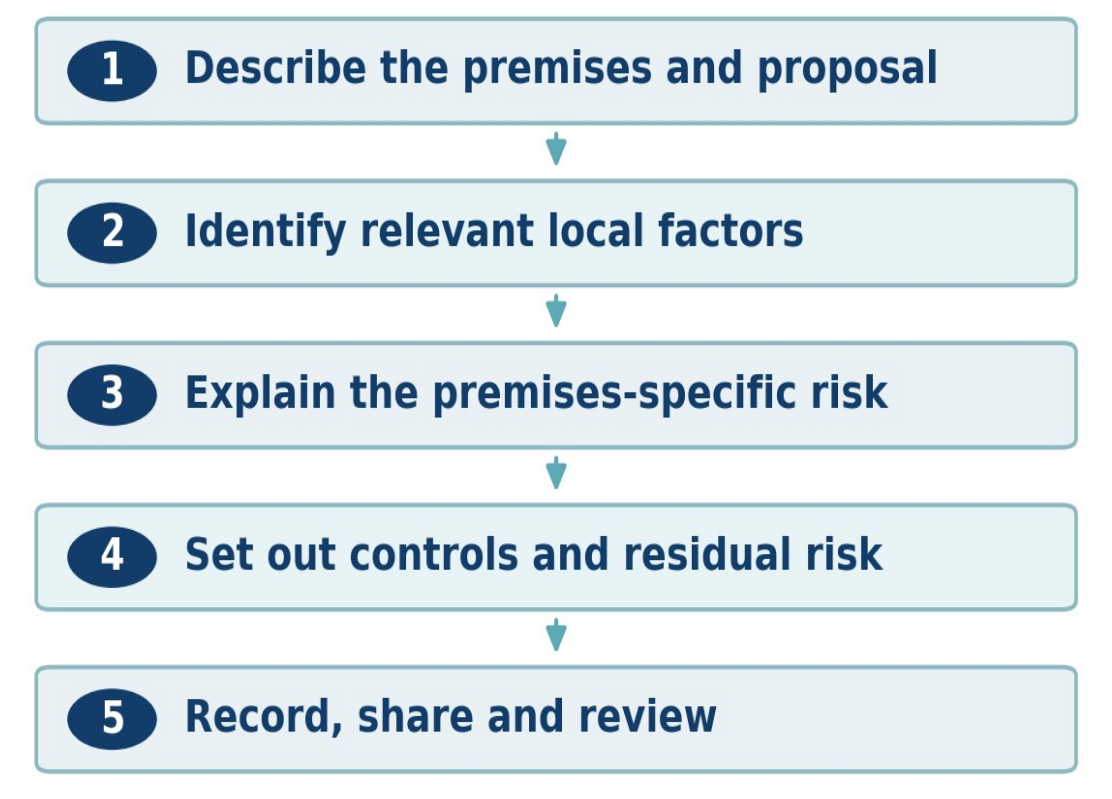
Figure 4 summarises the sequence an operator should follow. The assessment should move from the actual premises and local evidence to a clearly stated risk, workable controls and an honest assessment of what risk remains.
5.1 When a local risk assessment is required
LCCP social responsibility code 10.1.1 requires each applicable non-remote licensee to assess the local risks to the licensing objectives at each premises and to have policies, procedures and controls to mitigate them.
The operator must prepare or review the assessment:
- when applying for a new premises licence;
- when applying to vary a premises licence;
- when significant local circumstances change; and
- when a significant change at the premises may affect the way local risks are controlled.
5.2 What the assessment should contain
The assessment should be concise, current and specific to the premises. It should:
- Describe the premises and proposal: licence type, plan, gambling offer, machines, hours, access, layout, staffing and customer journey.
- Describe the actual location: observations at relevant dates and times, entrances, visibility, routes, neighbouring uses, transport, footfall and any seasonal pattern.
- Identify only the relevant risks: explain the people or circumstances affected, the possible harm, the licensing objective and the supporting evidence. State briefly why a prominent LAP theme is not relevant where that may otherwise be unclear.
- Set out the controls: who is responsible, how the measure operates, staff training and supervision, records, escalation and how effectiveness will be checked.
- Assess the residual risk and review arrangements: explain what remains, why the controls are sufficient, any action and completion date, and the events that will trigger review.
5.3 Sharing the assessment
LCCP ordinary code 10.1.2 says that operators should share the assessment with the Board when applying for a new premises licence or a variation, and otherwise on request. This is good practice rather than a separate statutory application requirement. The Commission also recommends keeping the current assessment at the premises.
Part 6 - How the board will use and update the profile
6.1 Use in applications and reviews
The Board will use the LAP to identify relevant questions and test the operator's evidence and controls. It will not assume that every theme applies to every premises or that an area-wide statistic proves a premises risk.
Where the Board relies on the LAP, its decision should make clear:
- the particular information relied on;
- why it is relevant to the premises and a licensing objective;
- the operator's evidence and response;
- any risk remaining after the controls; and
- why the outcome is lawful and proportionate.
Any premises condition must be necessary on the facts, related to the premises and the identified risk, proportionate to the scale and type of operation, and within the Board's statutory powers. It should not merely repeat a mandatory condition or an operating-licence requirement.
6.2 Keeping the profile current
Licensing will keep the premises register and map under review and will periodically check the main data, support routes and material partner information. A published update should identify its date, source and what changed. Public material will use aggregate or non-identifying information.
A factual update to the LAP does not restart or extend the Statement's statutory period, which ends on 30 January 2028. A decision will be based on the law and evidence current at the time, and an applicant or licence holder must have a fair opportunity to respond to any material information used in its case.